Advertisements
Advertisements
प्रश्न
Explain why a cyclist bends while negotiating a curve road? Arrive at the expression for angle of bending for a given velocity.
Advertisements
उत्तर
Let us consider a cyclist negotiating a circular level road (not banked) of radius r with a speed v. The cycle and the cyclist are considered as one system with mass m. The center gravity of the system is C and it goes in a circle of radius r with center at O. Let us choose the line OC as X-axis and the vertical line through O as Z-axis as shown in Figure.
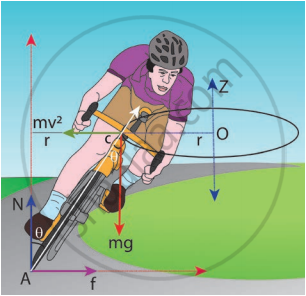
Bending of cyclist
The system as a frame is rotating about Z-axis. The system is at rest in this rotating frame. To solve problems in a rotating frame of reference, we have to apply a centrifugal force (pseudo force) on the system which will be `(mv^2)/r` This force will act through the center of gravity. The forces acting on the system are,
- gravitational force (mg)
- normal force (N)
- frictional force (f)
- centrifugal force `((mv^2)/r)`.
As the system is in equilibrium in the rotational frame of reference, the net external force and net external torque must be zero. Let us consider all torques about point A in Figure.
For rotational equilibrium,
τnet = 0
The torque due to the gravitational force about point A is (mg AB) which causes a clockwise turn that is taken as negative. The torque due to the centripetal force is I BC which causes an (`(mv^2)/r` BC) Which causes an anticlockwise turn that is taken as positive.

Force diagram for the cyclist in turns
`-mg AB + (mv^2)/r BC = 0`
mg AB = `(mv^2)/r`BC
From ΔABC
AB = AC sin θ and BC = AC cos θ
mg AC sin θ = `(mv^2)/r` AC cos θ
tan θ = `v^2/(rg)`
θ = `tan^-1(v^2/(rg))`
While negotiating a circular level road of radius r at velocity v, a cyclist has to bend by an angle 0 from vertical given by the above expression to stay in equilibrium (i.e. to avoid a fall).
