Advertisements
Advertisements
प्रश्न
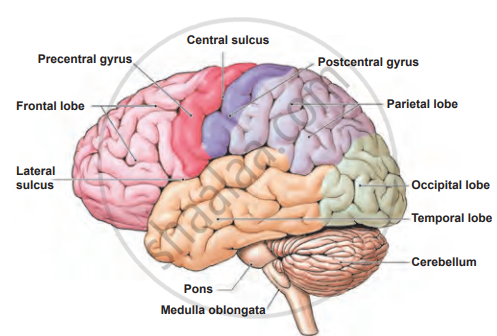
Explain the functions of various parts of the human brain.
स्पष्ट कीजिए
Advertisements
उत्तर
The brain is made up of fore brain, mid brain, and hind brain.
- Fore brain: Its main parts are the Cerebrum and Limbic system.
- Cerebrum: It is the largest part of the brain. It has two layers. The outer layer is grey in colour and is called the Cerebral Cortex. It regulates all the higher mental functions like attention, reasoning, learning, memory, etc. Its surface is wrinkled and divided into two symmetrical halves, i.e., the right hemisphere and left hemisphere. These two hemispheres are connected by a bundle of fibres called the corpus callosum.
Left hemisphere controls language while the right hemisphere controls spatial relations and pattern recognition. Each hemisphere of the cortex has four lobes, i.e., frontal, parietal, temporal and occipital lobes. Two main fissures include the Rolando (central) fissure (which divides the frontal lobe and parietal lobe) and the Sylvian (lateral) fissure (Separates the temporal lobe from the rest of the brain).- Frontal lobe: It lies behind the forehead. It plays a role in functions like thinking, memory, reasoning, etc. The Broca's area, which is responsible for speech production, lies here.
- Parietal lobe: It lies at the top of the skull, behind the frontal lobe. It is involved in motor control and understanding information regarding the skin senses like touch, pressure, temperature, and pain.
- Occipital lobe: It is situated at the back of the head, behind the parietal and temporal lobes. It is the centre for visual processing, i.e., to process information about colour, shape and movement of visual stimuli.
- Temporal lobe: It is located just above the ears. Hearing, understanding language, and memory for language take place due to the temporal lobe. The Wernicke's area, which is responsible for comprehension of language, lies in this lobe.
- Limbic System: The parts of the limbic system are:
- Hippocampus: It is responsible for episodic, long-term memories.
- Amygdala: It is involved in mediating emotions, especially fear. It stores the emotional memory of our experiences.
- Thalamus (relay station of the brain): It is an egg-shaped structure at the top of the brainstem. It receives all information from the sensory receptors in the body (except the sense of smell) and directs it to different areas of the cerebral cortex.
- Hypothalamus: It lies below the thalamus. Hypothalamus controls homeostatic mechanisms. It has centres for hunger, thirst, temperature regulation, sleep, etc. Hypothalamus is called the body's 'pleasure centre'. It also controls the pituitary gland.
- Cerebrum: It is the largest part of the brain. It has two layers. The outer layer is grey in colour and is called the Cerebral Cortex. It regulates all the higher mental functions like attention, reasoning, learning, memory, etc. Its surface is wrinkled and divided into two symmetrical halves, i.e., the right hemisphere and left hemisphere. These two hemispheres are connected by a bundle of fibres called the corpus callosum.
- Mid brain - It is the bridge between the hind brain and fore brain. It contains two small structures, viz., the superior colliculus, which controls eye movements and the inferior colliculus, which serves as the main auditory centre for the body.
- Hind brain: It's parts are Cerebellum, Brain Stem and Reticular Activation System.
- Cerebellum: It consists of two round structures. Cerebellum maintains body posture and body balance and coordinates muscle movement.
- Brain Stem: Its parts are Medulla Oblongata and Pons.
- Medulla oblongata: It is the lowest part of the brain stem, i.e., located at the base of the skull. Medulla is called the ‘vital centre of the brain’, as it controls vital functions like blood pressure, breathing rate, pulse rate and digestive activities. It sends sensory impulses to the brain and receives motor impulses from the brain.
- Pons (bridge): It is located above the medulla. Pons serves as a bridge between the two cerebral hemispheres. It sends and receives information from the lower parts of the brain. Pons is concerned with hearing and balance. It has motor neurones which control facial movement.
- Reticular Activation System: This is “Alarm clock” of the body. We are awake before time if we have to catch an early morning train. It happens as our reticular activating system elicits this response. It is also called as Reticular Formation which contains a bunch of neurones, and its main function is to maintain wakefulness, concentration and alertness.
shaalaa.com
क्या इस प्रश्न या उत्तर में कोई त्रुटि है?
