Advertisements
Advertisements
प्रश्न
Explain stabilizing, directional and disruptive selection with examples.
Advertisements
उत्तर
I. Stabilising selection (centipetal selection): This type of selection operates in a stable environment as shown in fig. The organisms with average phenotypes survive whereas the extreme individuals from both the ends are eliminated. There is no speciation but the phenotypic stability is maintained within the population over generation. For example, measurements of sparrows that survived the storm clustered around the mean, and the sparrows that failed to survive the storm clustered around the extremes of the variation showing stabilizing selection.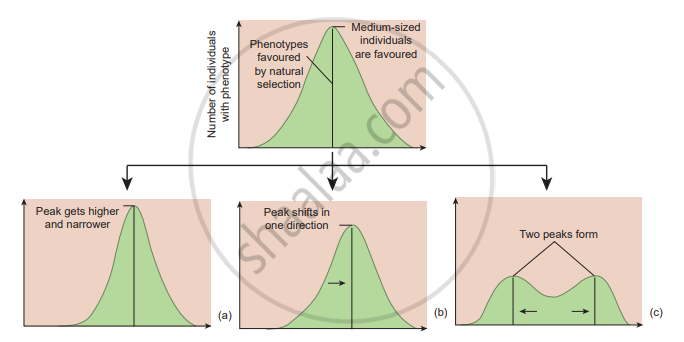
Operation of natural selection on different traits (a) Stabilising (b) Directional and (c) Disruptive
II. Directional Selection: The environment” which undergoes gradual change is subjected to directional selection, as shown in fig. This type of selection removes the individuals from one end towards the other end of phenotypic distribution. For example, size differences between male and female sparrows. Both male and female look alike externally but differ in body weight. Females show directional selection in relation to body weight.
III. Disruptive selection: (centrifugal selection) When homogenous environment changes into heterogenous environment this type of selection is operational as shown in fig. The organisms of both the extreme phenotypes are selected, whereas individuals with average phenotype are eliminated. This results in splitting of the population into sub population/species. This is a rare form of selection but leads to formation of two or more different species. It is also (called adaptive radiation. E.g: Darwin’s finches beak size in relation to seed size inhabiting Galapagos islands. Group selection and sexual selection are other types of selection. The two major group selections are Altrusim and Kin selection.
