Advertisements
Advertisements
प्रश्न
Explain consumer's equilibrium in case of a single commodity in terms cardinal utility theory.
Advertisements
उत्तर
| Units of Shirt | Marginal Utility (in ₹) |
| 1 | 700 |
| 2 | 650 |
| 3 | 600 |
| 4 | 500 |
| 5 | 350 |
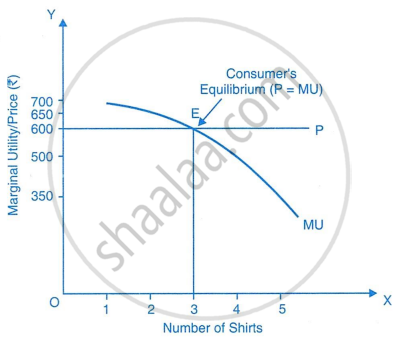
A numerical example of the consumer's equilibrium in a single commodity instance is shown in the table and graphic. Let's say the customer want to buy shirts. As shown in the table, he receives utility (measured in monetary terms) from various shirt units. The table makes it clear that the client receives ₹ 700 in marginal utility from the first shirt. The marginal utility continues to decrease as he consumes (purchases) more shirts. It is assumed that the shirt costs 600 rupees. When the customer buys three shirts, he will be in equilibrium since the third shirt's marginal utility (₹ 600) equals the shirt's price (₹ 600).
The marginal utility curve of shirts, represented in monetary terms, is known as the MU curve in the diagram. The law of diminishing marginal utility is indicated by the MU curve's downward slope. The cost of a garment is displayed by the horizontal line P. At point E, the price line P and the MU curve cross. Thus, at point E, where the MU = P, the consumer is in equilibrium.
When he buys three shirts in our the situation, this need is completed. MU > P at any point above E. For example, even if the second shirt costs ₹600, he is satisfied with it to the tune of ₹650. Therefore, by buying a second shirt, the customer can boost his overall utility. Similarly, MU < P at any point below E. Therefore, by making fewer purchases, the customer might be more satisfied. For example, the customer will not want to buy the fourth shirt because it only delivers him ₹500 in utility, which is less than the shirt's 600 price. Point E, then, is the equilibrium point where the shirt's MU equals its price.
As a result, when a customer equalizes the marginal utility he receives from a commodity with its price, he will be in equilibrium and will be maximizing total utility while making a purchase.
