Advertisements
Advertisements
प्रश्न
|
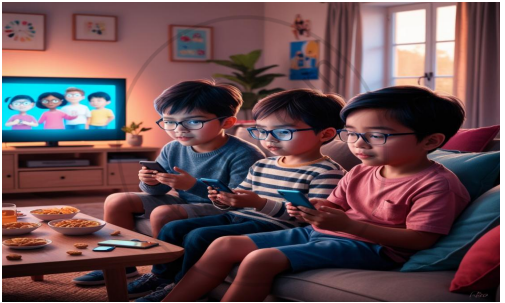
Excessive use of screens can result in vision problems, obesity, sleep disorders, anxiety, low retention problems and can impede social and emotional comprehension and expression. It is essential to be mindful of the amount of time we spend on screens and to reduce our screen time by taking regular breaks, setting time limits, and engaging in non-screen-based activities.
|
- What is the total percentage of students who suffer from anxiety and low retention issues in the class? (2)
- A student is selected at random, and he is found to suffer from anxiety and low retention issues. What is the probability that he/she spends screen time more than 4 hours per day? (2)
Advertisements
उत्तर
Let the events be
E1: The student is in the first group (time spent on screen is more than 4 hours).
E2: The student is in the second group (time spent on screen is 2 to 4 hours).
E3: The student is in the third group (time spent on screen is less than 2 hours).
A: The event of the student showing symptoms of anxiety and low retention.
Given that the first group with the high screen time is 60% of all the students, whereas the second group with moderate screen time is 30% and the third group with low screen time is only 10% of the total number of students.
So, we can write
P(E1) = 60% = `60/100`
P(E2) = 30% = `30/100`
P(E3) = 10% = `10/100`
Also, given that it was observed that 80% of students of the first group faced severe anxiety and low retention issues, with 70% of the second group and 30% of the third group having the same symptoms.
So, we can write
People with anxiety, and in 1st group = P(A|E1) = 80% = `80/100`
People with anxiety, and in 2nd group = P(A|E2) = 70% = `70/100`
People with anxiety, and in 3rd group = P(A|E3) = 30% = `30/100`
I. Basically we need to find the probability that a student has anxiety:
Now, P(student has anxiety) = P(student in 1st group) × P(student has anxiety and in 1st group) + P(student in 2nd group) × P(student has anxiety and in 2nd group) + P(student in 3rd group) × P(student has anxiety and in 3rd group)
P(A) = P(E1) × P(A|E1) + P(E2) × P(A|E2) + P(E3) × P(A|E3)
= `60/100 xx 80/100 + 30/100 xx 70/100 + 10/100 xx 30/100`
= `6/10 xx 8/10 + 3/10 xx 7/10 + 1/10 xx 3/10`
= `48/100 + 21/100 + 3/100`
= `(48 + 21 + 3)/100`
= `72/100`
= 72%
Thus, 72% students who suffer from anxiety and low retention issues in the class.
II. We need to find P(E1|A):
Using the conditional probability formula:
P(E1|A) = `(P(E_1 ∩ A))/(P(A))` ....(1)
Now, we found P(A) in the last part:
For P(E1 ∩ A), we can also write
P(A|E1) = `(P(A ∩ E_1))/(P(E_1))`
Putting values:
`80/100 = (P(A ∩ E_1))/(60/100)`
`80/100 xx 60/100` = P(A ∩ E1)
P(A ∩ E1) = `80/100 xx 60/100`
P(A ∩ E1) = `8/10 xx 6/10`
P(A ∩ E1) = `48/100`
Putting values in (1):
P(E1|A) = `(P(E_1 ∩ A))/(P(A))` ....(1)
= `(48/100)/(72/100)`
= `48/72`
= `6/9`
= `2/3`
Thus, required probability is `2/3`.
