Advertisements
Advertisements
प्रश्न
Draw the graph of the pair of linear equations x − y + 2 = 0 and 4x − y − 4 = 0. Calculate the area of the triangle formed by the lines so drawn and the x-axis.
Advertisements
उत्तर
For x − y + 2 = 0
When x = 1,
1− y + 2 = 0
−y + 3 = 0
y = 3
When x = 2,
2 − y + 2 = 0
4 − y = 0
y = 4
When x = 3,
3 − y + 2 = 0
5 − y = 0
y = 5
| x | 1 | 2 | 3 |
| y | 3 | 4 | 5 |
For 4x − y − 4 = 0
When x = 1,
4(1) − y − 4 = 0
4 − y − 4 = 0
0 − y = 0
y = 0
When x = 2,
4(2) − y − 4 = 0
8 − y − 4 = 0
4 − y = 0
y = 4
When x = 0,
4(0) − y − 4 = 0
0 − y − 4 = 0
y = − 4
| x | 1 | 2 | 0 |
| y | 0 | 4 | −4 |
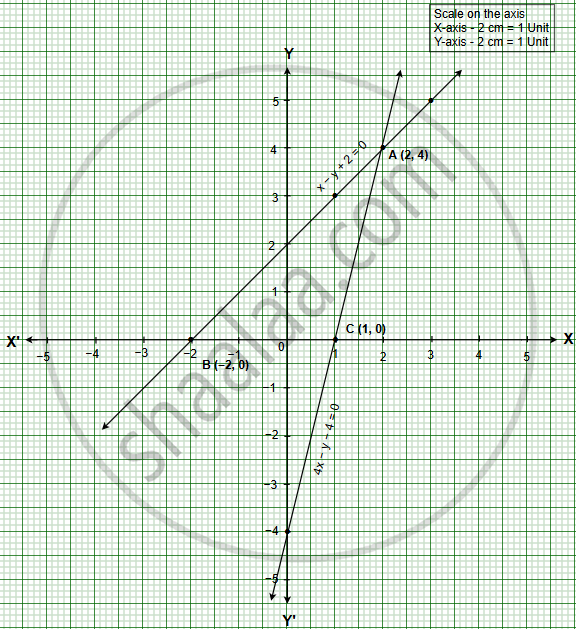
The triangle is formed by points A(2, 4), B(−2, 0) and C(1, 0).
Since both B and C lie on the x-axis, the base is the distance between their x-coordinates:
Base = |XC − XB|
= |1 − (−2)|
= 3 units
∴ The height is the perpendicular distance from vertex A to the x-axis, which is its y-coordinate:
Height = 4 units
∴ Area = `1/2 xx "Base" xx "Height"`
= `1/2 xx 3 xx 4`
= `1/2 xx 12`
= 6 sq. units
