Advertisements
Advertisements
प्रश्न
Draw ogive for the Following distribution and hence find graphically the limits of weight of middle 50% fishes.
| Weight of fishes (in gms) | 800 – 890 | 900 – 990 | 1000 – 1090 | 1100 – 1190 | 1200 – 1290 | 1300 –1390 | 1400 – 1490 |
| No. of fishes | 8 | 16 | 20 | 25 | 40 | 6 | 5 |
Advertisements
उत्तर
Since the given data is not continuous, we have to convert it in the continuous form by subtracting 5 from the lower limit and adding 5 to the upper limit of every class interval. To draw a ogive curve, we construct the less than cumulative frequency table as given below:
| Weight of fishes (in gms) |
No. of fishes (f) |
Less than cumulative frequency (c.f.) |
| 795 – 895 | 8 | 8 |
| 895 – 995 | 16 | 24 |
| 995 – 1095 | 20 | 44 |
| 1095 – 1195 | 25 | 69 |
| 1195 – 1295 | 40 | 109 |
| 1295 – 1395 | 6 | 115 |
| 1395 – 1496 | 5 | 120 |
| Total | 120 |
Points to be plotted are (895, 8), (995, 24),(1095, 44),(1195, 69),(1295, 109), (1395, 115), (1495, 120).
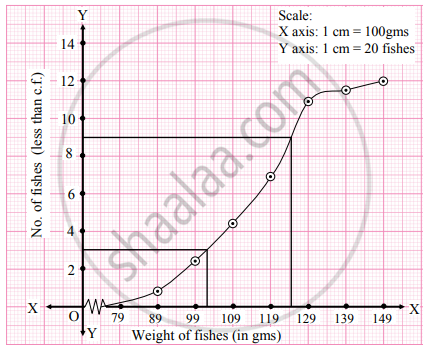
N = 120
For Q1 and Q3 we have to consider `"N"/4=120/4` = 30, `(3"N")/4=(3xx120)/4` = 90
For finding Q1 and Q3 we consider the values 30 and 90 on the Y-axis. From these points, we draw the lines which are parallel to X-axis. From the points where these lines intersect the less than ogive, we draw perpendicular on X-axis. The feet of perpendiculars represent the values of Q1 and Q2.
∴ Q1 ≈ 1025 and Q3 ≈ 1248
∴ The limits of weight of middle 50% fishes lie between 1025 to 1248.
APPEARS IN
संबंधित प्रश्न
The following table gives frequency distribution of marks of 100 students in an examination.
| Marks | 15 –20 | 20 – 25 | 25 – 30 | 30 –35 | 35 – 40 | 40 – 45 | 45 – 50 |
| No. of students | 9 | 12 | 23 | 31 | 10 | 8 | 7 |
Determine D6, Q1, and P85 graphically.
The following table gives the distribution of daily wages of 500 families in a certain city.
| Daily wages | No. of families |
| Below 100 | 50 |
| 100 – 200 | 150 |
| 200 – 300 | 180 |
| 300 – 400 | 50 |
| 400 – 500 | 40 |
| 500 – 600 | 20 |
| 600 above | 10 |
Draw a ‘less than’ ogive for the above data. Determine the median income and obtain the limits of income of central 50% of the families.
The following frequency distribution shows the profit (in ₹) of shops in a particular area of city:
| Profit per shop (in ‘000) | No. of shops |
| 0 – 10 | 12 |
| 10 – 20 | 18 |
| 20 – 30 | 27 |
| 30 – 40 | 20 |
| 40 – 50 | 17 |
| 50 – 60 | 6 |
Find graphically The limits of middle 40% shops.
The following frequency distribution shows the profit (in ₹) of shops in a particular area of city:
| Profit per shop (in ‘000) | No. of shops |
| 0 – 10 | 12 |
| 10 – 20 | 18 |
| 20 – 30 | 27 |
| 30 – 40 | 20 |
| 40 – 50 | 17 |
| 50 – 60 | 6 |
Find graphically the number of shops having profile less than 35,000 rupees.
The following is the frequency distribution of overtime (per week) performed by various workers from a certain company.
Determine the values of D2, Q2, and P61 graphically.
| Overtime (in hours) |
Below 8 | 8 – 12 | 12 – 16 | 16 – 20 | 20 – 24 | 24 and above |
| No. of workers | 4 | 8 | 16 | 18 | 20 | 14 |
Draw ogive for the following data and hence find the values of D1, Q1, P40.
| Marks less than | 10 | 20 | 30 | 40 | 50 | 60 | 70 | 80 | 90 |
| No. of students | 4 | 6 | 24 | 46 | 67 | 86 | 96 | 99 | 100 |
The following table shows the age distribution of head of the families in a certain country. Determine the third, fifth and eighth decile of the distribution graphically.
| Age of head of family (in years) |
Numbers (million) |
| Under 35 | 46 |
| 35 – 45 | 85 |
| 45 – 55 | 64 |
| 55 – 65 | 75 |
| 65 – 75 | 90 |
| 75 and Above | 40 |
Find graphically the values of D3 and P65 for the data given below:
| I.Q of students | 60 – 69 | 70 – 79 | 80 – 89 | 90 – 99 | 100 – 109 | 110 – 119 | 120 – 129 |
| No. of students | 20 | 40 | 50 | 50 | 20 | 10 | 10 |
Determine graphically the value of median, D3, and P35 for the data given below:
| Class | 10 – 15 | 15 – 20 | 20 – 25 | 25 – 30 | 30 – 35 | 35 – 40 | 40 – 45 |
| Frequency | 8 | 14 | 8 | 25 | 15 | 14 | 6 |
The I.Q. test of 500 students of a college is as follows:
| I.Q. | 20 – 30 | 30 – 40 | 40 – 50 | 50 – 60 | 60 – 70 | 70 – 80 | 80 – 90 | 90 – 100 |
| Number of students | 41 | 52 | 64 | 180 | 67 | 45 | 40 | 11 |
Find graphically the number of students whose I.Q. is more than 55 graphically.
Draw an ogive for the following distribution. Determine the median graphically and verify your result by mathematical formula.
| Height (in cms.) | No. of students |
| 145 − 150 | 2 |
| 150 − 155 | 5 |
| 155 − 160 | 9 |
| 160 − 165 | 15 |
| 165 − 170 | 16 |
| 170 − 175 | 7 |
| 175 − 180 | 5 |
| 180 − 185 | 1 |
Draw a cumulative frequency curve more than type for the following data and hence locate Q1 and Q3. Also, find the number of workers with daily wages
(i) Between ₹ 170 and ₹ 260
(ii) less than ₹ 260
| Daily wages more than (₹) | 100 | 150 | 200 | 250 | 300 | 350 | 400 | 450 | 500 |
| No. of workers | 200 | 188 | 160 | 124 | 74 | 49 | 31 | 15 | 5 |
