हिंदी

D Y D X + Y Cos X = Sin X Cos X - Mathematics

Advertisements
Advertisements

प्रश्न

\[\frac{dy}{dx}\] + y cos x = sin x cos x

योग
Advertisements

उत्तर

We have, 
\[\frac{dy}{dx} + y \cos x = \sin x \cos x . . . . . \left( 1 \right)\]
Clearly, it is a linear differential equation of the form
\[\frac{dy}{dx} + Py = Q\]
where
\[P = \cos x\]
\[Q = \sin x \cos x\]
\[ \therefore I.F. = e^{\int P\ dx} \]
\[ = e^{\int\cos x\ dx} \]
\[ = e^{\sin x} \]
\[\text{Multiplying both sides of }\left( 1 \right)\text{ by }e^{\sin x} ,\text{ we get }\]
\[ e^{\sin x} \left( \frac{dy}{dx} + y \cos x \right) = e^{\sin x} \sin x \cos x\]
\[ \Rightarrow e^{\sin x} \frac{dy}{dx} + e^{\sin x} y \cos x = e^{\sin x} \sin x\cos x \]
Integrating both sides with respect to x, we get
\[y\ e^{\sin x} = \int e^{\sin x} \sin x\cos \text{ x } dx + C\]
\[ \Rightarrow y e^{\sin x} = I + C . . . . . \left( 2 \right)\]
where
\[I = \int e^{\sin x} \sin x \cos \text{ x } dx\]
\[\text{Putting }t = \sin x,\text{ we get }\]
\[dt = \cos \text{ x }dx\]
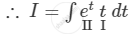
\[ = t\int e^t dt - \int\left[ \frac{d}{dt}\left( t \right)\int e^t dt \right]dt\]
\[ = t e^t - e^t \]
\[ = e^t \left( t - 1 \right)\]
\[ = e^{\sin x} \left( \sin x - 1 \right)\]
\[\text{Putting the value of I in }\left( 2 \right), \text{we get }\]
\[\text{ y } e^{\sin x} = e^{\sin x} \left( \sin x - 1 \right) + C\]
\[ \Rightarrow y = \sin x - 1 + C e^{- \sin x} \]
\[\text{Hence, }y = \sin x - 1 + C e^{- \sin x}\text{ is the required solution.}\]

shaalaa.com
  क्या इस प्रश्न या उत्तर में कोई त्रुटि है?
अध्याय 22: Differential Equations - Exercise 22.10 [पृष्ठ १०६]

APPEARS IN

आरडी शर्मा Mathematics [English] Class 12
अध्याय 22 Differential Equations
Exercise 22.10 | Q 28 | पृष्ठ १०६

वीडियो ट्यूटोरियलVIEW ALL [1]

संबंधित प्रश्न

For the differential equation, find the general solution:

`dy/dx  + 2y = sin x`


For the differential equation, find the general solution:

`dy/dx + 3y = e^(-2x)`


For the differential equation, find the general solution:

`x dy/dx +  2y= x^2 log x`


For the differential equation, find the general solution:

`x dy/dx + y - x + xy cot x = 0(x != 0)`


For the differential equation, find the general solution:

y dx + (x – y2) dy = 0


For the differential equation given, find a particular solution satisfying the given condition:

`dy/dx - 3ycotx = sin 2x; y = 2`  when `x = pi/2`


The population of a village increases continuously at the rate proportional to the number of its inhabitants present at any time. If the population of the village was 20000 in 1999 and 25000 in the year 2004, what will be the population of the village in 2009?


x dy = (2y + 2x4 + x2) dx


\[\frac{dy}{dx}\] = y tan x − 2 sin x


\[\left( \sin x \right)\frac{dy}{dx} + y \cos x = 2 \sin^2 x \cos x\]

\[\left( x^2 - 1 \right)\frac{dy}{dx} + 2\left( x + 2 \right)y = 2\left( x + 1 \right)\]

Find the general solution of the differential equation \[\frac{dy}{dx} - y = \cos x\]


Solve the differential equation \[\left( y + 3 x^2 \right)\frac{dx}{dy} = x\]


Find the particular solution of the differential equation \[\frac{dx}{dy} + x \cot y = 2y + y^2 \cot y, y ≠ 0\] given that x = 0 when \[y = \frac{\pi}{2}\].


Solve the differential equation \[\frac{dy}{dx}\] + y cot x = 2 cos x, given that y = 0 when x = \[\frac{\pi}{2}\] .


Solve the differential equation: `(1 + x^2) dy/dx + 2xy - 4x^2 = 0,` subject to the initial condition y(0) = 0.


Solve the following differential equation:

`dy/dx + y/x = x^3 - 3`


Solve the following differential equation:

`(1 - "x"^2) "dy"/"dx" + "2xy" = "x"(1 - "x"^2)^(1/2)`


Find the equation of the curve which passes through the origin and has the slope x + 3y - 1 at any point (x, y) on it.


If the slope of the tangent to the curve at each of its point is equal to the sum of abscissa and the product of the abscissa and ordinate of the point. Also, the curve passes through the point (0, 1). Find the equation of the curve.


The integrating factor of `(dy)/(dx) + y` = e–x is ______.


The integrating factor of the differential equation sin y `("dy"/"dx")` = cos y(1 - x cos y) is ______.


Integrating factor of `dy/dx + y = x^2 + 5` is ______ 


Integrating factor of the differential equation `(1 - x^2) ("d"y)/("d"x) - xy` = 1 is ______.


The solution of `(1 + x^2) ("d"y)/("d"x) + 2xy - 4x^2` = 0 is ______.


The equation x2 + yx2 + x + y = 0 represents


The integrating factor of the differential equation `x (dy)/(dx) - y = 2x^2` is


If y = y(x) is the solution of the differential equation, `(dy)/(dx) + 2ytanx = sinx, y(π/3)` = 0, then the maximum value of the function y (x) over R is equal to ______.


Let y = f(x) be a real-valued differentiable function on R (the set of all real numbers) such that f(1) = 1. If f(x) satisfies xf'(x) = x2 + f(x) – 2, then the area bounded by f(x) with x-axis between ordinates x = 0 and x = 3 is equal to ______.


Let y = y(x) be the solution curve of the differential equation `(dy)/(dx) + ((2x^2 + 11x + 13)/(x^3 + 6x^2 + 11x + 6)) y = ((x + 3))/(x + 1), x > - 1`, which passes through the point (0, 1). Then y(1) is equal to ______.


The solution of the differential equation `dx/dt = (xlogx)/t` is ______.


If sec x + tan x is the integrating factor of `dy/dx + Py` = Q, then value of P is ______.


Solve:

`xsinx dy/dx + (xcosx + sinx)y` = sin x


Share
Notifications

Englishहिंदीमराठी


      Forgot password?
Use app×