Advertisements
Advertisements
प्रश्न
Consider the given electric circuit:
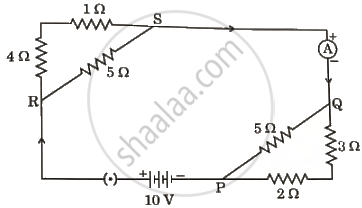
Calculate the following:
- Total resistance of the circuit.
- The electric current drawn from the battery.
- Potential difference between points P and Q.
Advertisements
उत्तर
a. In the upper branch, the 4 Ω and 1 Ω resistors are in series.
⇒ 4 + 1 = 5Ω
This 5 Ω branch is in parallel with the other 5 Ω resistor.
The equivalent resistance between R and S:
RRS = `(5 xx 5)/(5 + 5)`
= `25/10`
= 2.5 Ω
In the lower branch, 3 Ω and 2 Ω resistors are in series.
⇒ 3 + 2 = 5 Ω
This 5 Ω branch is in parallel with the middle 5 Ω resistor.
Equivalent resistance between P and Q:
RPQ = `(5 xx 5)/(5 + 5)`
= `25/10`
= 2.5 Ω
The two networks are connected in series.
∴ Total resistance (Rtotal) = RRS + RPQ
= 2.5 + 2.5
= 5 Ω
b. By using Ohm’s law:
V = IR
I = `V/R_"total"`
= `10/5`
= 2 A
c. The total current of 2 A flows through the equivalent resistance of the P-Q section (RPQ).
VPQ = I × RPQ
= 2 × 2.5
= 5 V
