Advertisements
Advertisements
प्रश्न
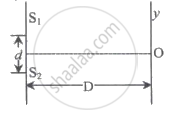
Consider a usual set-up of Young's double slit experiment with slits of equal intensity as shown in the figure. Take 'O' as the origin and the Y axis as indicated. If the average intensity between y1 = `(lambdaD)/(4d)` and y2 = `(lambdaD)/(4d)` equals n times the intensity of maximum, then n equal is (take average over phase difference) ______.
विकल्प
`1/2(1 + 2/pi)`
`2(1 + 2/pi)`
`(1 + 2/pi)`
`1/2(1 - 2/pi)`
Advertisements
उत्तर
Consider a usual set-up of Young's double slit experiment with slits of equal intensity as shown in the figure. Take 'O' as the origin and the Y axis as indicated. If the average intensity between y1 = `(lambdaD)/(4d)` and y2 = `(lambdaD)/(4d)` equals n times the intensity of maximum, then n equal is (take average over phase difference) `underlinebb(1/2(1 + 2/pi))`.
Explanation:
Phase difference corresponding to `y_1 = (-pi)/2` and that for `y_2 = +pi/2`
∴ Average intensity between y1 and y2,
= `1/piint_{-pi/2}^{pi/2}I_{max} cos^2(Phi/2)dPhi`
= `I_{max} ((pi + 2))/(2pi)`
Hence required ratio = `1/2(1 + 2/pi)`
