Advertisements
Advertisements
प्रश्न
Collect information on the following and discuss in the class:
- Major journeys carried out by explorers in the last millennium
- Discovery of continents, countries, and islands
- Spread of culture, trade, and religions
Comment on how oceans have played a major role in all the three points mentioned above.
कृति
Advertisements
उत्तर
- Major Journeys by Explorers (Last Millennium):
The last millennium, particularly from the 15th to 18th centuries (known as the Age of Discovery or Exploration), saw transformative maritime expeditions, primarily led by European powers.- Viking Explorations (c. 1000 AD): Leif Erikson reached North America (Newfoundland) centuries before Columbus, establishing a brief settlement, demonstrating early transatlantic capabilities.
- Zheng He's Voyages (1405-1433): The Chinese Admiral Zheng He led massive "treasure ship" expeditions across the South China Sea and Indian Ocean, extending China's influence and engaging in extensive trade before China adopted isolationist policies.
- Christopher Columbus (1492-1504): Financed by Spain, Columbus made four voyages across the Atlantic, reaching the Caribbean islands and the Central/South American coasts, intending to find a westward route to Asia. His journeys marked the beginning of European colonization of the Americas.
- Vasco da Gama (1497-1499): The Portuguese explorer was the first European to establish a direct sea route from Europe to India by sailing around the Cape of Good Hope in Africa. This bypassed overland routes controlled by the Ottoman Empire and established a lasting European maritime presence in Asia.
- Ferdinand Magellan (1519-1522): Though killed in the Philippines, his expedition completed the first circumnavigation of the globe under Juan Sebastián Elcano. This proved the Earth could be circumnavigated by sea and opened up the Pacific Ocean to European navigation.
- Captain James Cook (1768-1779): The British navigator made three major voyages to the Pacific Ocean, accurately charting New Zealand and the east coast of Australia, and reaching the Hawaiian Islands, significantly expanding European geographical knowledge.
- Discovery of Continents, Countries, and Islands:
European explorers "discovered" and mapped many lands previously unknown to them (though inhabited by indigenous peoples), leading to global maps that are recognizable today.- The Americas: First reached by Columbus (1492), later recognized as new continents and named "America" after Amerigo Vespucci, who mapped much of the South American coastline.
- Brazil: Discovered by Portuguese navigator Pedro Álvares Cabral in 1500 during a voyage to India.
- Australia and New Zealand: The Dutch were the first Europeans to sight parts of Australia (Willem Janszoon in 1606) and New Zealand (Abel Tasman in 1642), with James Cook later charting the east coast of Australia in detail.
- Pacific Ocean: Numerous Pacific islands, including the Hawaiian Islands, were systematically mapped and recorded by explorers like James Cook.
- Spread of Culture, Trade, and Religions:
These journeys created the first interconnected global system, leading to widespread exchange (the Columbian Exchange) but also colonization and exploitation.- Trade: Oceans served as the central highways for the global trade of valuable commodities like spices, silk, tea, gold, silver, and tobacco. The control of sea routes became the basis for European colonial empires and immense wealth.
- Religion: Christian missionaries, particularly Spanish and Portuguese, traveled with explorers and colonizers to the Americas, Africa, and Asia, establishing churches and converting indigenous populations, making Catholicism a dominant religion in many regions. Similarly, Islam spread across the Indian Ocean via Arab traders and scholars.
- Culture and Ideas: The movement of people led to significant cultural diffusion, including languages (e.g., Spanish, English, and Portuguese became global languages), new technologies, scientific knowledge, art forms, and even diseases, which drastically affected native populations in the Americas.
- The Pivotal Role of Oceans:
Oceans were not merely backdrops; they were the essential pathways and drivers for all these developments:- Natural Highways: Before modern aviation, oceans were the only way to move large quantities of goods and people across continents efficiently. Navigating them was the key to bypassing existing land-based routes (like those controlled by the Ottomans).
- Facilitating Exploration: Advancements in maritime technology (e.g., compass, astrolabe, improved ship design like the caravel) allowed sailors to venture into the open oceans, breaking myths and expanding geographical knowledge.
- Dependence on Ocean Systems: Early Indian Ocean trade relied heavily on understanding and utilizing predictable monsoon winds to facilitate seasonal voyages. This predictability allowed merchants to plan trade efficiently.
- Economic Drivers: The immense potential for profit from maritime trade, especially the spice trade, provided the primary motivation and funding for these risky expeditions by governments and merchant companies like the Dutch East India Company.
- Connecting the World: Oceans laid the groundwork for the modern, globalized world by physically connecting previously isolated continents and facilitating the ongoing exchange that continues to shape our societies today.
shaalaa.com
Introduction of Ocean Resources
क्या इस प्रश्न या उत्तर में कोई त्रुटि है?
APPEARS IN
संबंधित प्रश्न
Look at the figure and answer the following question.
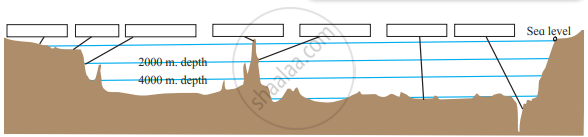
- What does the figure show?
- In which part of the figure is the ocean shallow? Which human activities can be carried out here?
- In which part does deposition of sediments occur?
- Where in the figure do you find islands formed due to submerged mountains?
- Label the figure with the correct names of landforms.
- Compare these features with the landforms on the earth.
Find out the name and locations of islands located in India and list them in the above given categories.
Complete the chain:
| A | B | C |
| 1) Continental Shelf | 1) deeper part | 1) Manganese nodules |
| 2) Oceanic microorganisms | 2) Abyssal plains | 2) Whales |
| 3) Oceanic Trenches | 3) fishing | 3) Sunda |
| 4) Vast Flat Area | 4) plankton | 4) Dogger Bank |
Show the following on the map of the World:
- Chagos Range
- Mariana Trench
- Dogger Bank
- Mumbai High
- Sunda Deep
- Grand Banks
