Advertisements
Advertisements
प्रश्न
|
Climate change and global warming are influencing storm behaviour, particularly in terms of intensity and rainfall. Strong winds and storms often cause uprooting and/or breaking of trees, which damage the vehicles standing underneath the trees. On a particular day, during a high intensity storm, a tree broke such that its broken part formed an angle of 30° with the ground. The distance between the base of the tree to the point where the top touches the ground is found to be 10 m.
|
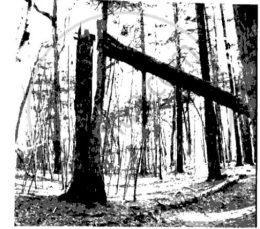
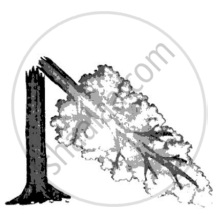
Based on the above information, answer the following questions:
(i) Represent the given information with the help of a neat and well-labelled diagram. [1]
(ii) Find the height above the ground at which the tree is broken. [1]
(iii) (a) Find the height of the tree before it broke. (Use `sqrt(3) = 1.732`) [2]
OR
(iii) (b) If another tree broke from the same height as in part (ii), but the broken part made a 60° angle with the ground, find the total height of the tree. [2]
Advertisements
उत्तर
(i) Labelled diagram:
|
Right-Angled Triangle ABC Representing a Broken Tree
|
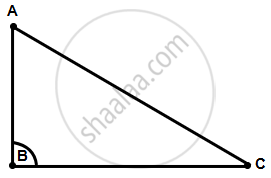
(ii) Height at which tree is broken (AB):
In △ABC, ∠B = 90° and ∠C = 30°
BC = 10 m
`tan 30^circ = (AB)/(BC)`
`1/sqrt(3) = (AB)/10`
`AB = 10/sqrt(3) m`
(iii) (a) Total height of the tree:
Total height = AB + AC
In △ABC:
`cos 30^circ = (BC)/(AC)`
`sqrt(3)/2 = 10/(AC)`
`AC = 20/sqrt(3) m`
Total height = `10/sqrt(3) + 20/sqrt(3) = 30/sqrt(3)`
= `10sqrt(3) m`
= 10 × 1.732
= 17.32 m
OR
(iii) (b) Total height of new tree:
Given: Height of broken part above ground `(AB) = 10/sqrt(3) m`
New angle with ground = 60°
Let the new broken part be AC"
In △ABC':
`sin 60^circ = (AB)/(AC'')`
`sqrt(3)/2 = (10sqrt(3))/(AC'')`
`AC'' = 10/sqrt(3) xx 2/sqrt(3) = 20/3 m`
Total height = AB + AC''
= `10/sqrt(3) + 20/3`
= `(10sqrt(3))/3 + 20/3`
= `(10(1.732) + 20)/3`
= `(17.32 + 20)/3`
= `(37.32)/3`
= 12.44 m
