Advertisements
Advertisements
प्रश्न
Calculate the enthalpy of hydrogenation of ethylene from the following data.
Bond energies of C − H, C − C, C = C and H − H are 414, 347, 618 and 435 kJ mol−1.
Advertisements
उत्तर
Given, EC−H = 414 kJ mol−1
EC−C = 347 kJ mol−1
EC=C = 618 kJ mol−1
EH−H = 435 kJ mol−1
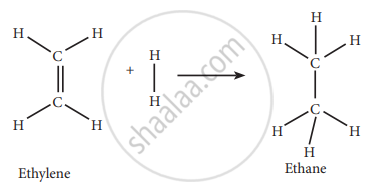
ΔHr = Σ (Bond energy)r − Σ (Bond energy)p
ΔHr = (EC=C + 4EC−H + EH−H) − (EC−C + 6EC−H)
ΔHr = (618 + (4 × 414) + 435) − (347 + (6 × 414))
ΔHr = 2709 − 2831
ΔHr = −122 kJ mol−1
APPEARS IN
संबंधित प्रश्न
The correct thermodynamic conditions for the spontaneous reaction at all temperature is
∆S is expected to be maximum for the reaction
What is the unit of entropy?
Identify the state and path functions out of the following:
- Enthalpy
- Entropy
- Heat
- Temperature
- Work
- Free energy
State the various statements of the second law of thermodynamics.
What are spontaneous reactions?
Calculate the entropy change in the system, and surroundings, and the total entropy change in the universe during a process in which 245 J of heat flows out of the system at 77°C to the surrounding at 33°C.
30.4 kJ is required to melt one mole of sodium chloride. The entropy change during melting is 28.4 JK−1 mol−1. Calculate the melting point of sodium chloride.
Cyanamide (NH2CN) is completely burnt in excess oxygen in a bomb calorimeter, ΔU was found to be −742.4 kJ mol−1, calculate the enthalpy change of the reaction at 298 K.\[\ce{NH2CN_{(s)} + 3/2 O2_{(g)} -> N2_{(g)} + CO2_{(g)} + H2O_{(l)}}\] ΔH = ?
For the reaction at 298 K: \[\ce{2A + B -> C}\]
ΔH = 400 KJ mol−1; ΔS = 0.2 KJ K−1 mol−1 Determine the temperature at which the reaction would be spontaneous.
