Advertisements
Advertisements
प्रश्न
Bulb A rated 160 W, 40 V and Bulb B rated 40 W, 40 V are connected as shown in the diagram.
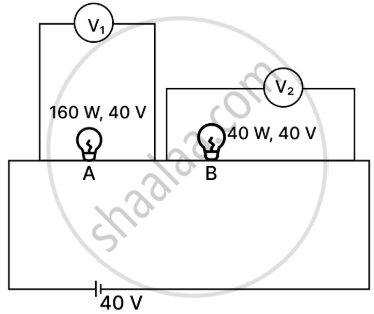
- Calculate the ratio V1 : V2.
- If the bulb fuses, the current in the circuit remains the same.
State True or False.
Advertisements
उत्तर
Given: Power rating of the bulb A (PA) = 160 W
Voltage rating of the bulb A (VA) = 40 V
Power rating of the bulb B (PB) = 40 W
Voltage rating of the bulb B (VB) = 40 V
Supply voltage (V) = 40 V
a. Resistance of bulb A is given by,
RA = `(V_A^2)/P_A`
= `40^2/160`
= `1600/160`
= 10 Ω
Similarly,
The resistance of bulb B is given by,
RB = `V_B^2/P_B`
= `40^2/40`
= `1600/40`
= 40 Ω
From Ohm’s law,
Potential drop (V) = Current (I) × Resistance (R)
Since the bulbs are in series, the same current flows through both bulbs, and the potential difference divides in the ratio of their resistances, i.e.,
V1 : V2 = RA : RB
= 10 : 40
= 1 : 4
Hence, the ratio V1 : V2 = 1 : 4.
b. This statement is false.
Explanation:
If bulb A fuses, the circuit becomes open, so no current can flow through the circuit. Hence, the current becomes zero, not the same.
