Advertisements
Advertisements
प्रश्न
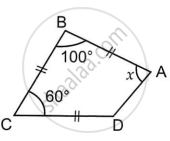
Assertion: In the quadrilateral ABCD, AB = BC = CD. ∠B = 100°, ∠C = 60°, then ∠A = 70°.
Reason: Join BD, ΔBCD is equilateral and ΔABD isosceles.
विकल्प
Both A and R are true and R is the correct reason for A.
Both A and R are true but R is the incorrect reason for A.
A is true but R is false.
A is false but R is true.
Advertisements
उत्तर
Both A and R are true and R is the correct reason for A.
Explanation:
Given AB = BC = CD, so three consecutive sides are equal.
∠B = 100° and ∠C = 60° are given.
If the quadrilateral is such that when BD is joined,
- ΔBCD is equilateral means BC = CD = BD and all angles of ΔBCD are 60°.
- ΔABD is isosceles means AB = BD.
Since AB = BC = CD and BD equals BC and CD (in equilateral ΔBCD), BD = AB also. Therefore, ΔABD is isosceles with AB = BD.
Then calculating ∠A in ΔABD will lead to ∠A = 70° (based on sum of angles in triangles and given angle at B).
Therefore:
- The assertion that ∠A = 70° is true.
- The reason that ΔBCD is equilateral (so BD equals BC and CD) and ΔABD is isosceles is also true.
- Moreover, the reason correctly explains why ∠A = 70° (i.e., joining BD helps determine these properties and angles).
