Advertisements
Advertisements
प्रश्न
An infinitely large thin plane sheet has a uniform surface charge density +σ. Obtain the expression for the amount of work done in bringing a point charge q from infinity to a point, distant r, in front of the charged plane sheet.
Advertisements
उत्तर
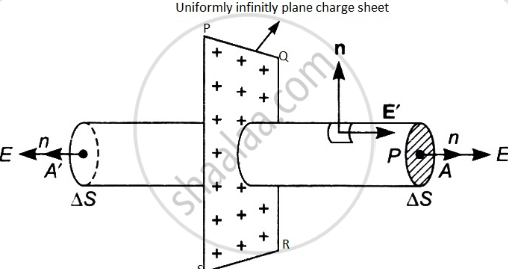
Let PQRS is an infinitely plane charged sheet and +σ be the distribution of charge over the sheet. Let the charge q is bringing from infinity to the distance r from the sheet.
then, Electric field at the distant r from the sheet
Φ = E. ΔScosθ
∴ Φ = E. ΔS(θ = 0) .......(1)
and Φ = `σ/∈_0` .......(2)
From equation (1) and (2)
E = `σ/[ ∈_0 xx ΔS ]`
E = `σ/[ ∈_0 xx 2 ]`
We know that,
W = F.r
W = q . `σ/[ ∈_0 xx 2 ]`.r
संबंधित प्रश्न
A thin metallic spherical shell of radius R carries a charge Q on its surface. A point charge`Q/2` is placed at its centre C and an other charge +2Q is placed outside the shell at a distance x from the centre as shown in the figure. Find (i) the force on the charge at the centre of shell and at the point A, (ii) the electric flux through the shell.

Find the ratio of the potential differences that must be applied across the parallel and series combination of two capacitors C1 and C2 with their capacitances in the ratio 1 : 2 so that the energy stored in the two cases becomes the same.
A small conducting sphere of radius 'r' carrying a charge +q is surrounded by a large concentric conducting shell of radius Ron which a charge +Q is placed. Using Gauss's law, derive the expressions for the electric field at a point 'x'
(i) between the sphere and the shell (r < x < R),
(ii) outside the spherical shell.
How is the field directed if (i) the sheet is positively charged, (ii) negatively charged?
A charge Q is uniformly distributed on a spherical shell. What is the field at the centre of the shell? If a point charge is brought close to the shell, will the field at the centre change? Does your answer depend on whether the shell is conducting or non-conducting?
A spherical shell made of plastic, contains a charge Q distributed uniformly over its surface. What is the electric field inside the shell? If the shell is hammered to deshape it, without altering the charge, will the field inside be changed? What happens if the shell is made of a metal?
A positive point charge Q is brought near an isolated metal cube.
A circular wire-loop of radius a carries a total charge Q distributed uniformly over its length. A small length dL of the wire is cut off. Find the electric field at the centre due to the remaining wire.
“A uniformly charged conducting spherical shell for the points outside the shell behaves as if the entire charge of the shell is concentrated at its centre”. Show this with the help of a proper diagram and verify this statement.
