Advertisements
Advertisements
प्रश्न
An exterior angle of a triangle is 108° and its interior opposite angles are in the ratio 4 : 5. The angles of the triangle are
विकल्प
48°, 60°, 72°
50°, 60°, 70°
52°, 56°, 72°
42°, 60°, 76°
Advertisements
उत्तर
In the given ΔABC, an exterior angle ∠ADC = 108° and its interior opposite angles are in the ratio 4:5.
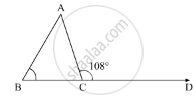
Let us take,
∠A = 4x
∠B = 5x
Now using the property, “exterior angle of a triangle is equal to the sum of two opposite interior angles”
We get,
∠A + ∠B = 108°
4x + 5x = 108°
9x = 108°
`x = (108°)/ 9`
x = 12
Thus,
∠A = 4x = 4(12°) = 48°
∠B = 5x = 5(12°) = 60°
Also, using angle sum property in ΔABC
∠A + ∠B + ∠C = 180°
48° + 60° + ∠C = 180°
108° + ∠C = 180°
∠C = 180° - 108°
∠C = 72°
Thus,
∠A = 48°
∠B = 60°
∠C = 72°
APPEARS IN
संबंधित प्रश्न
Is the following statement true and false :
All the angles of a triangle can be greater than 60°.
In Δ ABC, if u∠B = 60°, ∠C = 80° and the bisectors of angles ∠ABC and ∠ACB meet at a point O, then find the measure of ∠BOC.
In ΔABC, if bisectors of ∠ABC and ∠ACB intersect at O at angle of 120°, then find the measure of ∠A.
If the side BC of ΔABC is produced on both sides, then write the difference between the sum of the exterior angles so formed and ∠A.
Find the unknown marked angles in the given figure:
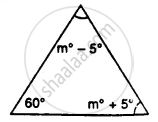
In ∆ABC, C = 56° C = 56° ∠B = ∠C and ∠A = 100° ; find ∠B.
Classify the following triangle according to sides:
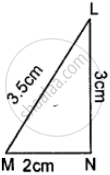
The length of the sides of the triangle is given. Say what types of triangles they are 4.3 cm, 4.3 cm, 4.3 cm.
The length of the three segments is given for constructing a triangle. Say whether a triangle with these sides can be drawn. Give the reason for your answer.
17 cm, 7 cm, 8 cm
The number of angles in the following figure is ______.

