Advertisements
Advertisements
प्रश्न
Aman has ₹ 1500 to purchase rice and wheat for his grocery shop. Each sack of rice and wheat costs ₹ 180 and Rupee ₹ 120 respectively. He can store a maximum number of 10 bags in his shop. He will earn a profit of ₹ 11 per bag of rice and ₹ 9 per bag of wheat.
- Formulate a Linear Programming Problem to maximise Aman’s profit.
- Calculate the maximum profit.
Advertisements
उत्तर
i. Let x be the number of rice sacks purchased and y be the number of wheat sacks purchased.
Cost of each sack of rice = ₹ 180
Cost of each sach of wheat = ₹ 120
Profit earned on each sack of rice = ₹ 11
Profit earned on each sack of wheat = ₹ 9
As a result, the problem can be expressed as LPP as follows:
Maximum P = 11x + 9y,
Subject to the constraints
180x + 120y ≤ 1500
or 3x + 2y ≤ 25 ...(i)
x + y ≤ 10 ...(ii)
x, y > 0
ii. Draw the lines 3x + 2y = 25 and x + y = 10 and shade the area bounded by the given inequations. The shaded region represents a bounded feasible region. Lines 3x + 2y = 25 and x + y = 10 intersect at (5, 5).
For equation (i)
3x + 2y = 25
| x | 0 | `25/2` |
| y | `25/3` | 0 |
Points: `(0, 25/2), (25/3, 0)`
For equation (ii)
x + y = 10
| x | 0 | 10 |
| y | 10 | 0 |
Points: (0, 10), (10, 0)
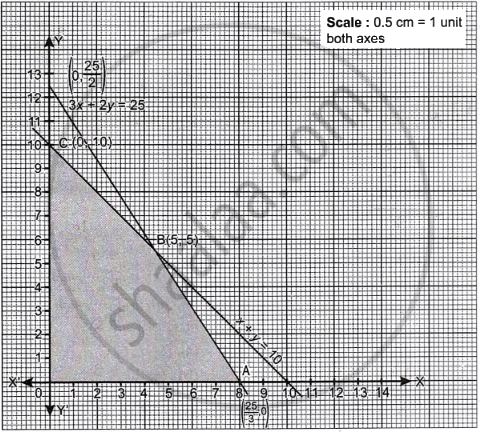
The four corner points of the feasible region OABC are O(0, 0), `A(25/3, 0)`, B(5, 5), C(0, 10)
At each corner point, we calculate Z = 11x + 9y.
| Corner points | Value of objective function Z = 11x + 9y |
| O(0, 0) | Z = 11 × 0 + 9 × 0 = 0 |
| `A(25/3, 0)` | Z = `11 xx 25/3 + 9 xx 0 = 275/3` |
| B(5, 5) | Z = 11 × 5 + 9 × 5 = 100 |
| C(0, 10) | Z = 11 × 0 + 9 × 10 = 90 |
P is found to be greatest at B(5, 5), with a maximum value of P = 100.
Hence, Aman earns the greatest profit of ₹ 100 when purchasing 5 sacks of rice and 5 sacks of wheat.
