Advertisements
Advertisements
प्रश्न
ABCD is a trapezium in which side AB is parallel to side DC. P is the mid-point of side AD. IF Q is a point on the Side BC such that the segment PQ is parallel to DC, prove that PQ = `(1)/(2)("AB" + "DC")`.
Advertisements
उत्तर
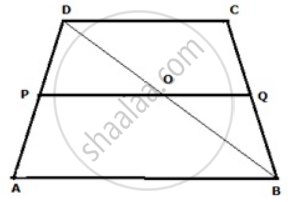
PQ || DC ⇒ OQ || DC ||AB
Therefore, Q and O are mid-points of BC and BD respectively.
In ΔABD,
P and O are mid-points of AD and BD respectively
⇒ OP = `(1)/(2)"AB"` ........(i)
In ΔBCD,
Q and O are mid-points of BC and BD respectively
⇒ OQ = `(1)/(2)"CD"` ........(ii)
Adding (i) and (ii)
OP + OQ = `(1)/(2)"AB" + (1)/(2)"CD"`
⇒ PQ = `(1)/(2)("AB" + "CD")`.
संबंधित प्रश्न
ABCD is a parallelogram. P and Q are mid-points of AB and CD. Prove that APCQ is also a parallelogram.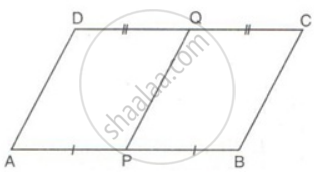
SN and QM are perpendiculars to the diagonal PR of parallelogram PQRS.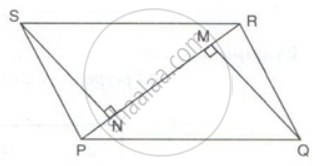
Prove that:
(i) ΔSNR ≅ ΔQMP
(ii) SN = QM
ABCD is a parallelogram. P and T are points on AB and DC respectively and AP = CT. Prove that PT and BD bisect each other.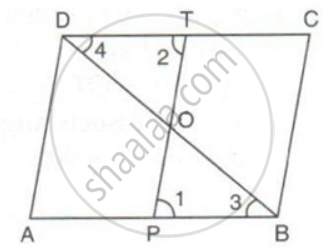
ABCD is a rectangle with ∠ADB = 55°, calculate ∠ABD.
Prove that the line segment joining the mid-points of the diagonals of a trapezium is parallel to each of the parallel sides, and is equal to half the difference of these sides.
PQRS is a parallelogram and O is any point in its interior. Prove that: area(ΔPOQ) + area(ΔROS) - area(ΔQOR) + area(ΔSOP) = `(1)/(2)`area(|| gm PQRS)
In the given figure, AB ∥ SQ ∥ DC and AD ∥ PR ∥ BC. If the area of quadrilateral ABCD is 24 square units, find the area of quadrilateral PQRS.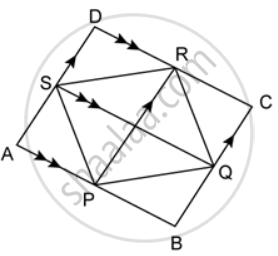
In the given figure, PQ ∥ SR ∥ MN, PS ∥ QM and SM ∥ PN. Prove that: ar. (SMNT) = ar. (PQRS).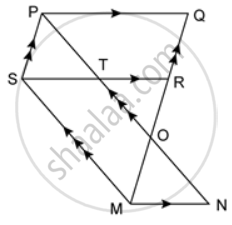
In ΔPQR, PS is a median. T is the mid-point of SR and M is the mid-point of PT. Prove that: ΔPMR = `(1)/(8)Δ"PQR"`.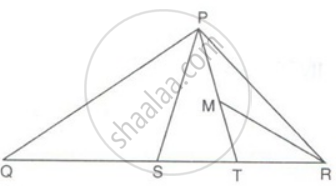
In the figure, ABCD is a parallelogram and CP is parallel to DB. Prove that: Area of OBPC = `(3)/(4)"area of ABCD"`