Advertisements
Advertisements
प्रश्न
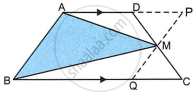
ABCD is a trapezium in which AD || BC. M is the mid-point of CD. Through M, PQ is drawn || to AB with P on AD produced and Q on BC.
- Show that ΔDPM ≅ ΔCQM
- Prove that area of ΔABM = `1/2` × area of trapezium ABCD.
प्रमेय
Advertisements
उत्तर
We are given:
- Trapezium ABCD with AD || BC
- M is midpoint of CD
- PQ || AB with P on AD extended and Q on BC
We are asked to:
- Show ΔDPM ≅ ΔCQM
- Prove Area(ΔABM) = `1/2` × Area(trapezium ABCD)
Show ΔDPM ≅ ΔCQM
Step 1: Observe triangles
- Consider ΔDPM and ΔCQM.
- PQ || AB, so by corresponding angles ∠DPM = ∠CQM
- M is midpoint of CD, so DM = MC
- PM || QC, so ΔDPM and ΔCQM are between parallel lines with equal lengths on opposite sides
Step 2: Use SAS congruence
In ΔDPM and ΔCQM:
- DM = MC ...(Given, M midpoint of CD)
- ∠DPM = ∠CQM ...(Alternate interior angles, PQ || AB)
- PM = QC ...(Segments between parallel lines are equal, by midpoint construction)
By SAS rule,
ΔDPM ≅ ΔCQM
Prove Area(ΔABM) = `bb(1/2)` × Area(trapezium ABCD)
Step 1: Draw median from midpoint
- M is midpoint of CD
- Draw line AM
- Trapezium ABCD area formula:
Area(trapezium) = `1/2 xx (AB + DC) xx "height"`
Step 2: Divide trapezium into triangles
- Draw diagonal AC (or median AM)
- ΔABM + ΔAMC = ΔABC
- By congruence from step i, area(ΔDPM) = area(ΔCQM)
- Using triangle subtraction and parallel lines,
Area(ΔABM) = `1/2` Area(ABCD)
shaalaa.com
क्या इस प्रश्न या उत्तर में कोई त्रुटि है?
