Advertisements
Advertisements
प्रश्न
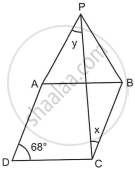
ABCD is a rhombus, ΔPAB is equilateral, ∠D = 68°. Find the values of x and y.
Advertisements
उत्तर
Step-by-step
Step 1: Utilize Properties of Rhombus and Equilateral Triangle
It is known that in a rhombus, all sides are equal in length.
Therefore, AB = BC = CD = DA.
It is also known that in an equilateral triangle, all sides are equal and all angles are 60°.
Thus, in ΔPAB, PA = PB = AB and ∠PAB = ∠PBA = ∠APB = 60°.
Step 2: Determine Angles in the Rhombus
In a rhombus, opposite angles are equal.
Given ∠D = 68°, it follows that ∠ABC = ∠D = 68°.
Adjacent angles in a rhombus are supplementary.
Therefore, ∠A = 180° – ∠B = 180° – 68° = 112°.
Step 3: Identify Isosceles Triangle PBC
From Step 1, it is established that AB = PB and AB = BC. Consequently, PB = BC.
This implies that ΔPBC is an isosceles triangle and the base angles opposite the equal sides are equal, so ∠BCP = ∠BPC = x.
Step 4: Calculate Angle PBC
The angle ∠PBC is formed by the sum of ∠PBA and ∠ABC.
∠PBC = ∠PBA + ∠ABC = 60° + 68° = 128°.
Step 5: Solve for x in Triangle PBC
The sum of angles in ΔPBC is 180°.
Therefore, ∠BPC + ∠BCP + ∠PBC = 180°.
Substituting the known values, x + x + 128° = 180°.
This simplifies to 2x = 180° – 128° = 52°.
Solving for x, x = `52^circ/2` = 26°.
Step 6: Solve for y
It is given that ∠APB = 60°.
The angle ∠APB is composed of ∠APD and ∠DPB.
Also, ∠APB = ∠APD + ∠DPB.
From the diagram, it is observed that ∠APB = ∠APD + ∠DPB = y + x.
Therefore, 60° = y + x.
Substituting the value of x found in Step 5, 60° = y + 26°.
Solving for y, y = 60° – 26° = 34°.
