Advertisements
Advertisements
प्रश्न
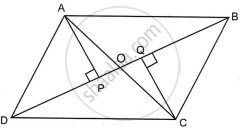
ABCD is a quadrilateral in which AP and CQ are perpendicular to diagonal BD and AP = CQ. Prove that BD bisects AC.
Advertisements
उत्तर
Given:
ABCD is a quadrilateral in which AP and CQ are perpendicular to the diagonal BD.
AP = CQ
To Prove: BD bisects AC, meaning that M, the point of intersection of BD and AC, divides AC into two equal parts, i.e., AM = MC.
Proof:
1. Perpendiculars and Given Conditions:
From the given information, AP and CQ are perpendicular to BD, meaning:
∠APB = 90°
∠CQD = 90°
Also, AP = CQ ...(Given)
2. Consider Triangles ΔABP and ΔCDQ:
We have the following information:
AP = CQ ...(Given)
∠APB = ∠CQD = 90° ...(Since both are perpendicular)
BP = DQ ...(Since BD is a common side and the perpendiculars divide BD into equal segments)
Therefore, by the Hypotenuse-Leg (HL) Congruence Theorem (since both triangles are right-angled and share the leg BD and hypotenuses AP and CQ of equal length) ΔABP ≅ ΔCDQ.
3. Corresponding Parts of Congruent Triangles:
Since ΔABP ≅ ΔCDQ, their corresponding parts are equal:
AB = CD
BP = DQ
4. Point M is the Midpoint of AC:
Now, consider the intersection of diagonal BD with AC.
Since BD is a common side of congruent triangles ΔABP and ΔCDQ, the point of intersection M divides AC into two equal segments.
Specifically, since AB = CD, the line BD must bisect AC, meaning AM = MC.
Thus, BD bisects AC.
