Advertisements
Advertisements
प्रश्न
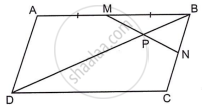
ABCD is a parallelogram. M is the mid-point of AB and P is a point on diagonal BD such that BP = `1/4` BD. MP produced meets BC at N. Prove that:
- N is a mid-point of BC.
- MN = `1/2` AC
Advertisements
उत्तर
Given:
- ABCD is a parallelogram.
- M is the midpoint of AB, i.e, AM = MB.
- P is a point on diagonal BD such that `BP = 1/4 BD`, meaning P divides BD in the ratio 1 : 3.
- The line segment MP is extended to meet BC at N.
We need to prove:
- N is a midpoint of BC,
- `MN = 1/2 AC`.
Step 1: Set up a coordinate system
Since ABCD is a parallelogram, let’s place it in the coordinate plane for simplicity.
We assign the following coordinates:
- A(0, 0),
- B(b, 0),
- D(0, d),
- C(b, d).
So, the coordinates of the vertices of the parallelogram are:
- A(0, 0),
- B(b, 0),
- C(b, d),
- D(0, d).
Step 2: Coordinates of M, P and N
1. Midpoint M:
Since M is the midpoint of AB, the coordinates of M are the average of the coordinates of A(0, 0) and B(b, 0):
`M = ((0 + b)/2, (0 + 0)/2) = (b/2, 0)`
2. Point P:
Point P divides the diagonal BD in the ratio 1 : 3. The coordinates of B are (b, 0) and the coordinates of D are (0, d).
Using the section formula, the coordinates of P are:
`P = ((3b + 0)/4, (3 * 0 + d)/4) = ((3b)/4, d/4)`
3. Equation of line MP:
Now, we will find the equation of line MP.
The slope of MP is given by:
Slope of MP = `(d/4 - 0)/((3b)/4 - b/2)`
= `(d/4)/(b/4)`
= `d/b`
The equation of the line MP in point-slope form is:
`y - 0 = d/b (x - b/2)`
Which simplifies to:
`y = d/b (x - b/2)`
4. Point N on line BC:
The line BC has coordinates B(b, 0) and C(b, d), so it is a vertical line with equation x = b.
Substituting x = b into the equation of line MP, we get:
`y = d/b (b - b/2)`
= `d/b xx b/2`
= `d/2`
Therefore, the coordinates of point N are `(b, d/2)`.
Step 3: Prove that N is a midpoint of BC
The coordinates of B are (b, 0) and the coordinates of C are (b, d).
The midpoint of BC has coordinates:
Midpoint of BC = `(b, (0 + d)/2) = (b, d/2)`
This is exactly the coordinates of N.
Hence, N is a midpoint of BC.
Step 4: Prove that `MN = 1/2 AC`
Now, we will prove that `MN = 1/2 AC`
1. Length of AC: The length of AC is the distance between A(0, 0) and C(b, d).
Using the distance formula:
`AC = sqrt((b - 0)^2 + (d - 0)^2`
= `sqrt(b^2 + d^2)`
2. Length of MN: The length of MN is the distance between `M(b/2, 0)` and `N(b, d/2)`.
Using the distance formula:
`MN = sqrt((b - b/2)^2 + (d/2 - 0)^2`
= `sqrt((b/2)^2 + (d/2)^2`
= `1/2 sqrt(b^2 + d^2)`
Thus, we have:
`MN = 1/2 AC`
