Advertisements
Advertisements
प्रश्न
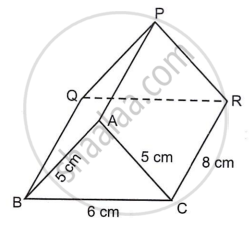
ABC is the cross-section of the prism. Find the surface area and volume of the prism if AB = AC = 5 cm, BC = 6 cm and CR = 8 cm.
Advertisements
उत्तर
We have,
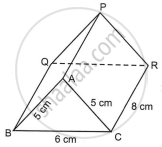
ABC is the cross-section of the prism.
If AB = AC = 5 cm, BC = 6 cm and CR = 8 cm
Now we know that,
The area of a triangle is `sqrt(s(s - a)(s - b)(s - c))`, where s is the semi-perimeter, a, b, c are the sides of a triangle
Then, in ΔABC
`s = (5 + 5 + 6)/2 = 8` cm
Then, area of the ΔABC = `sqrt(88 - 58 - 58 - 6)`
= 12 cm2
Now area of ΔABC = Area of ΔPQR
Then, area of ΔABC + Area of ΔPQR = 12 + 12 = 24 cm2
Now the area of a rectangle is (length)(breadth)
Then, area of the face ACRP = (5)(8) = 40 cm2
Area of the face ACRP = Area of the face ABQP
Then, area of face ACRP + Area of face ABQP = 40 + 40 = 80 cm2
And the area of the face BCRQ = (6)(8) = 48 cm2
The surface area of the prism = Area of ΔABC + Area of ΔPQR + Area of the face ACRP + Area of the face ABQP + Area of the face BCRQ
Therefore, the surface area of the prism = 12 + 12 + 40 + 40 + 48 = 152 cm2
And the volume of the prism = (Surface area of the cross-section ΔABC) × (Length)
= 12 × 8
= 96 cm3
