Advertisements
Advertisements
प्रश्न
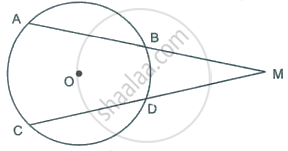
AB and CD are two equal chords of a circle with centre O, intersecting each other outside the circle at point M.
Prove that:
- AM = CМ
- BM = DM
Advertisements
उत्तर
Given: AB and CD are two equal chords of a circle with centre O; the two chords extended meet at an external point M, as in the figure.
To Prove:
- AM = CM.
- BM = DM.
Proof [Step-wise]:
1. Put notation:
Let AM = x, MB = y, CM = u and MD = v.
All these are positive lengths; by the picture the order on each secant is ABM and CDM.
So, x > y and u > v.
2. Power of a point M for two secants through M gives MA × MB = MC × MD.
i.e., x × y = u × v. ...(Equation 1)
3. Express chord lengths in terms of these segments.
On the secant ABM, we have AM = AB + BM.
So, AB = AM – BM = x – y.
Similarly, CD = CM – MD = u – v.
Since AB = CD (given), x – y = u – v. ...(Equation 2)
4. From (2) rearrange:
x – u = y – v
Call this common difference s.
So, x = u + s and y = v + s. ...(s may be positive, zero, or negative a priori)
5. Substitute x = u + s and y = v + s into (1):
(u + s)(v + s) = uv
⇒ uv + s(u + v) + s2 = uv
⇒ s(u + v) + s2 = 0
⇒ s(s + u + v) = 0
6. u and v are positive lengths.
So, s + u + v = x + v > 0.
Therefore, the factor (s + u + v) cannot be zero, hence s = 0.
7. s = 0 gives x – u = 0 and y – v = 0.
i.e., x = u and y = v.
Thus, AM = CM and BM = DM.
