Advertisements
Advertisements
प्रश्न
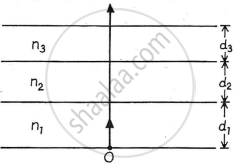
A vessel of depth d is filled upto a depth of d1 by a liquid of refractive index n1 upto a depth of d2 by a liquid of refractive index n2 and upto a depth of d3 by a liquid of refractive index n3. Show that the apparent depth of the vessel when viewed normally is given by:
`h_(app) = (d_1/n_1 + d_2/n_2 + d_3/n_3)`
[here d = d1 + d2 + d3 and n1 > n2 > n3]
Advertisements
उत्तर
When light travels from a denser medium to a rarer one, it bends away from the normal. Due to this bending (refraction), submerged objects appear to be at a shallower depth than they actually are. This is called apparent depth.
If a vessel is filled with three transparent liquids of refractive indices n1 > n2 > n3 and respective depths d1, d2, and d3, each layer contributes an apparent thickness when viewed normally from above.
Using the relation for a single medium:
Apparent depth = `"Real depth"/"Refractive index"`
So for all three layers:
`h_(app) = (d_1/n_1 + d_2/n_2 + d_3/n_3)`
