Advertisements
Advertisements
प्रश्न
A tree standing on a horizontal plane is leaning towards the east. At two points situated at distances a and b exactly due west on it, the angles of elevation of the top are respectively α and β. Prove that the height of the top from the ground is `((b - a)tan alpha tan beta)/(tan alpha - tan beta)`
Advertisements
उत्तर
Let OP be the tree and A, B be the two points such OA = a and OB = b and angle of elevation to the tops are α and β respectively.
Let OL = x and PL = h
We have to prove the following
`h = ((b - a)tan alpha tan beta)/(tan alpha - tan beta)`
The corresponding figure is as follows
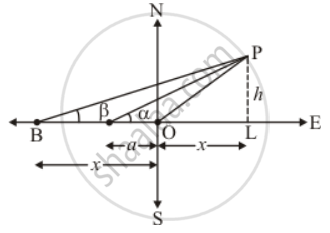
In ΔALP
`=> tan alpha = (PL)/(OA + OL)`
`=> tan alpha = h/(a + x)`
`=> 1/(cot alpha) = h/(a + x)`
`=> h cot alpha = a + x`.....(1)
Again in ΔBLP
`=> tan beta = (PL)/(OB + OL)`
`=> tan beta = h/(b + x)`
`=> 1/(cot beta) = h/(b + x)`
`=> h cot beta = b + x` .....(2)
Subtracting equation (1) from (2) we get
`=> h cot beta - hcot alpha = b - a`
`=> h(cot beta - cot alpha) = b - a`
`=> h (b -a)/(cot beta - cot alpha)`
`h = ((b - a)tan alpha tan beta)/(tan alpha - tan beta)`
Hence height of the top from ground is `h = ((b -a) tan alpha tan beta)/((tan alpha - tan beta))`
