Advertisements
Advertisements
प्रश्न
Read the following paragraph and answer the questions that follow.
| A thin lens is a transparent optical medium bounded by two surfaces, at least one of which should be spherical. Applying the formula for image formation by a single spherical surface successively at the two surfaces of a lens, one can obtain the ‘lens maker formula’ and then the ‘lens formula’. A lens has two foci - called ‘first focal point’ and ‘second focal point’ of the lens, one on each side. |
(i)
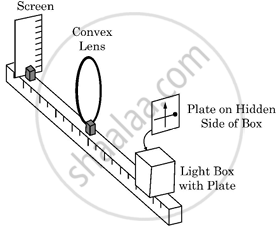
Consider the arrangement shown in figure. A black vertical arrow and a horizontal thick line with a ball are painted on a glass plate. It serves as the object. When the plate is illuminated, its real image is formed on the screen.
Which of the following correctly represents the image formed on the screen?


(ii) Which of the following statements is incorrect?
- For a convex mirror magnification is always negative.
- For all virtual images formed by a mirror magnification is positive.
- For a concave lens magnification is always positive.
- For real and inverted images, magnification is always negative.
(iii) A convex lens of focal length ‘f’ is cut into two equal parts perpendicular to the principal axis. The focal length of each part will be ______.
- f
- 2 f
- `f/2`
- `f/4`
OR
(iii) If an object in case (i) above is 20 cm from the lens and the screen is 50 cm away from the object, the focal length of the lens used is:
- 10 cm
- 12 cm
- 16 cm
- 20 cm
(iv) The distance of an object from first focal point of a biconvex lens is X1 and distance of the image from second focal point is X2. The focal length of the lens is ______.
- X1X2
- `sqrt(X_1 + X_2)`
- `sqrt(X_1 X_2)`
- `sqrt(X_2/X_1)`
Advertisements
उत्तर
(i)

Explanation:
A painted glass plate is positioned in front of a convex lens in the configuration provided, and a screen displays the actual image of the object. The item is made up of a black vertical arrow and a horizontal thick line with a ball.
Since an object placed beyond the focus point of a convex lens creates an actual, inverted picture, the image that appears on the screen will be:
- Vertically inverted: The object’s upward-pointing arrow will now point downward in the picture.
- No horizontal inversion: There is no change in the left-right orientation.
The ball will continue to be on the same side. Option (D) accurately depicts the vertical inversion while preserving the same horizontal orientation, making it the ideal representation of the actual image that appears on the screen.
(ii) For a convex mirror magnification is always negative.
Explanation:
Magnification is positive because convex mirrors always create virtual, upright pictures.
(iii) A convex lens of focal length ‘f’ is cut into two equal parts perpendicular to the principal axis. The focal length of each part will be f.
Explanation:
Because the surface’s curvature is constant, the lens formula is the same for every half-lens. The focal length of each component stays the same as the original lens because the lens’s refractive power is solely determined by its curvature and refractive index.
OR
(iii) 12 cm
Explanation:
`1/f = 1/v - 1/u`
f = `(uv)/(u - v)`
= `(30(-20))/(-20 - 30)`
= `(-600)/-50`
= 12 cm
(iv) The distance of an object from first focal point of a biconvex lens is X1 and distance of the image from second focal point is X2. The focal length of the lens is `bbunderline(sqrt(X_1 X_2))`.
Explanation:
Object distance (u) = −(X1 + f)
Image distance (v) = X2 + f
From the lens formula:
`1/f = 1/v - 1/u`
`1/f = 1/(X_2 + f) - 1/(-(X_1 + f))`
`1/f = 1/(X_2 + f) + 1/(X_1 + f)`
`1/f = ((X_2 + f) + (X_1 + f))/((X_2 + f)(X_1 + f))`
1 = `(f(X_1 + X_2 + 2f))/((X_2 + f)(X_1 + f))`
(X2 + f) (X2 + f) = f(X1 + X2 + 2f)
X1X2 + f2 = 2f2
X1X2 = f2
f = `sqrt(X_1X_2)`
