Advertisements
Advertisements
प्रश्न
A student wants to study a decomposition reaction by taking ferrous sulphate crystals. Write two precautions he must observe while performing the experiment.
Advertisements
उत्तर
Precautions for the decomposition reaction of reffous sulphate crystals.
\[\ce{\underset{\text{(Light Green)Feffous sulphate crystals}}{FeSO4.7H2O} ->[\Delta] \underset{\text{(white)Anhydrous ferrous sulphage}}{FeSO4} ->[\Delta] \underset{\text{(Brown)Ferric Oxide}}{Fe2O3} + SO2 + SO3}\]
(1) The mouth of the boiling tube should not be at pointed.
(2) Waft gases are emitted from FeSO4 on heating . The gases SO2 and SO3 are very harmful , so deep breath should not be taken when smelling the odour of the gases .
(3) Test tube holder must be used while heating the test tube.
APPEARS IN
संबंधित प्रश्न
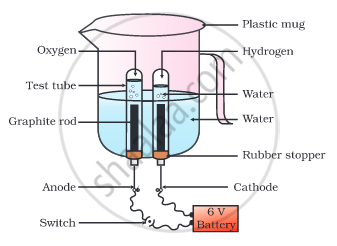
Why is the amount of gas collected in one of the test tubes in the following Activity double of the amount collected in the other? Name this gas.
- Take a plastic mug. Drill two holes at its base and fit rubber stoppers in these holes. Insert carbon electrodes in these rubber stoppers as shown in the following Fig.
- Connect these electrodes to a 6 volt battery.
- Fill the mug with water such that the electrodes are immersed. Add a few drops of dilute sulphuric acid to the water.
- Take two test tubes filled with water and invert them over the two carbon electrodes.
- Switch on the current and leave the apparatus undisturbed for some time.
- You will observe the formation of bubbles at both the electrodes. These bubbles displace water in the test tubes.
- Is the volume of the gas collected the same in both the test tubes?
• Once the test tubes are filled with the respective gases, remove them carefully. - Test these gases one by one by bringing a burning candle close to the mouth of the test tubes.
Caution: This step must be performed carefully by the teacher.
- What happens in each case?
- Which gas is present in each test tube?
Write one equation for decomposition reactions where energy is supplied in the form of heat.
Decomposition reactions require energy either in the form of heat or light or electricity for breaking down the reactants. Write one equation each for decomposition reactions where energy is supplied in the form of heat, light and electricity
Rewrite the following statements by selecting the correct options:
\[\ce{CaCO3 ->[\Delta] CaO + CO2 ^}\] is a __________ reaction.
A solid substance P which is very hard is used in the construction of many buildings, especially flooring. When substance P is heated strongly, it decomposes to form another solid Q and a gas R is given out. Solid Q reacts with water with the release of a lot of heat to form a substance S. When gas R is passed into a clear solution of substance S, then a white precipitate of substance T is formed. The substance T has the same chemical composition as starting substance P.
- What is substance P? Write its common name as well as chemical formula.
- What is substance Q?
- What is gas R?
- What is substance S? What is its clear solution known as?
- What is substance T? Name any two natural forms in which substance T occurs in nature.
Explain the following type of chemical reaction, giving two examples for it:
Decomposition reaction
Identify the type of following reaction :

Differentiate between direct combination reaction and a decomposition reaction.
Complete the statement by filling in the blank with the correct word:
Decomposition of silver salts in the presence of sunlight is an example of _________.
Which one of the following processes involves chemical reactions?
