हिंदी

A Ray of Light Passes from a Vacuum to a Medium of Refractive Index (μ). the Angle of Incidence is Found to Be Twice the Angle of Refraction. the Angle of Incidence is - Physics

Advertisements
Advertisements

प्रश्न

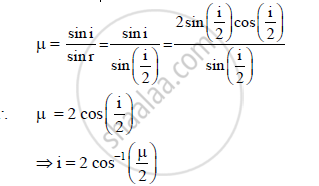
A ray of light passes from a vacuum to a medium of refractive index (μ). The angle of
incidence is found to be twice the angle of refraction. The angle of incidence is _______.

A) `cos^(-1)(mu/2)`

B) cos−1(μ)

C)  `2 cos^(-1) (mu/2)`

D) `2 sin^(-1) (mu/2)`

Advertisements

उत्तर

For i = 2r
shaalaa.com
  क्या इस प्रश्न या उत्तर में कोई त्रुटि है?
2012-2013 (October)

APPEARS IN

वीडियो ट्यूटोरियलVIEW ALL [3]

संबंधित प्रश्न

If the polarising angle for a given medium is 60°, then the refractive index of the medium is.................


What is a Polaroid?


With the help of neat diagram, explain how non-polar dielectric material is polarised in external electric field of increasing intensity. Define polarisation in dielectrics.


Three identical polaroid sheets P1, P2 and P3 are oriented so that the pass axis of P2 and P3 are inclined at angles of 60° and 90° respectively with the pass axis of P1. A monochromatic source S of unpolarised light of intensity I0 is kept in front of the polaroid sheet P1 as shown in the figure. Determine the intensities of light as observed by the observer at O, when polaroid P3 is rotated with respect to P2 at angles θ = 30° and 60°.


What dose a polaroid consist of?


Show, with the help of a diagram, how unpolarised sunlight gets polarised due to scattering.


Using the phenomenon of polarisation, show how the transverse nature of light can be demonstrated.


Show, via a suitable diagram, how unpolarised light can be polarised by reflection.


Two polaroids P1 and P2 are placed with their pass axes perpendicular to each other. Unpolarised light of intensity I0 is incident on P1. A third polaroid P3 is kept in between P1 and P2 such that its pass axis makes an angle of 60° with that of P1. Determine the intensity of light transmitted through P1, P2 and P3.


Show using a proper diagram how unpolarised light can be linearly polarised by reflection from a transparent glass surface.


What does a polaroid consist of? How does it produce a linearly polarised light?


Green light is incident at the polarising angle on a certain transparent medium. The angle of refraction is 30° . Find
(i) polarising angle, and
(ii) refractive index of the medium.


A ray of light is incident on a transparent medium at a polarizing angle. What is the angle between the reflected ray and the refracted ray?


What is the difference between polarised light and unpolarised light? 


Explain how an unpolarised light gets polarised when incident on the interface separating the two transparent media.


The transverse nature of light is shown in ______.


Discuss polarisation by selective absorption.


What is plane polarised light?


What is unpolarised light?


What is partially polarised light?


Discuss about Nicol prism.


How is polarisation of light obtained by scattering of light?


An unpolarised light of intensity 32 Wm-2 passes through three Polaroids such that the axes of the first and the last Polaroids are at 90°. What is the angle between the axes of the first and middle Polaroids so that the emerging light has an intensity of only 3 Wm-2?


The reflected light is found to be plane polarised when an unpolarized light falls on a denser medium at 60° with the normal. Find the angle of refraction and critical angle of incidence for total internal reflection in the denser to rarer medium reflection.


A plane mirror produces a magnification of


Which of the following phenomena is not common to sound and light waves?


A polarizer - analyser set is adjusted such that the intensity of light coming out of the analyser is just 10% of the original intensity. Assuming that the polarizer - analyser set does not absorb any light, the angle by which the analyser need to be rotated further to reduce the output intensity to be zero, is ______.


Share
Notifications

Englishहिंदीमराठी


      Forgot password?
Use app×