Advertisements
Advertisements
प्रश्न
A quadrilateral ABCD is inscribed in a circle such that AB is a diameter and ∠ADC = 130º. Find ∠BAC.
Advertisements
उत्तर
Draw a quadrilateral ABCD inscribed in a circle having centre O.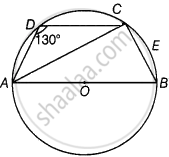
Given, ∠ADC = 130°
Since, ABCD is a quadrilateral inscribed in a circle, therefore ABCD becomes a cyclic quadrilateral.
∵ Since, the sum of opposite angles of a cyclic quadrilateral is 180°.
∴ ∠ADC + ∠ABC = 180°
⇒ 130° + ∠ABC = 180°
⇒ ∠ABC = 50°
Since, AB is a diameter of a circle, then AB subtends an angle to the circle is right angle.
∴ ∠ACB = 90°
In ΔABC, ∠BAC + ∠ACB + ∠ABC = 180° ...[By angle sum property of a triangle]
⇒ ∠BAC + 90° + 50° = 180°
⇒ ∠BAC = 180° – (90° + 50°)
= 180° – 140°
= 40°
APPEARS IN
संबंधित प्रश्न
In two concentric circles, prove that all chords of the outer circle which touch the inner circle are of equal length.
A chord PQ of a circle of radius 10 cm substends an angle of 60° at the centre of circle. Find the area of major and minor segments of the circle.
A quadrilateral ABCD is drawn to circumscribe a circle. Prove that AB + CD = AD + BC ?
Draw circle with the radii given below.
2 cm
In a circle, AB and CD are two parallel chords with centre O and radius 10 cm such that AB = 16 cm and CD = 12 cm determine the distance between the two chords?
The radius of a circle of diameter 24 cm is _______
If d1, d2 (d2 > d1) be the diameters of two concentric circles and c be the length of a chord of a circle which is tangent to the other circle, then ______
Three circles touch each other externally. The distance between their centres is 5 cm, 6 cm, and 7 cm. Find the radii of the circles.
If a chord AB subtends an angle of 60° at the centre of a circle, then angle between the tangents at A and B is also 60°.
Let s denote the semi-perimeter of a triangle ABC in which BC = a, CA = b, AB = c. If a circle touches the sides BC, CA, AB at D, E, F, respectively, prove that BD = s – b.
