Advertisements
Advertisements
प्रश्न
A potentiometer circuit is shown in Figure 3 below. AB is a uniform metallic wire having length of 2 m and resistance of 8 Ω. The batteries E1 and E2 have emfs of 4 V and 1.5 V and their internal resistances are 1 Ω and 2 Ω respectively.
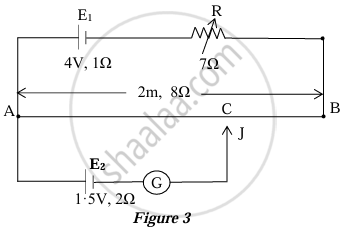
- When the jockey J does not touch the wire AB, calculate:
- the current flowing through the potentiometer wire AB.
- the potential gradient across the wire AB.
- Now the jockey J is made to touch the wire AB at a point C such that the galvanometer (G) shows no deflection. Calculate the length AC.
संख्यात्मक
Advertisements
उत्तर
i. When jockey J does not touch the wire AB:
a. E1 = 4 V
R = (7 + 8) = 15 Ω
r = 1 Ω
Current through AB,
I1 = `E_1/(R + r)`
= `4/(15 + 1)`
= `4/16`
= 0.25 A
b. Potential difference across wire AB,
VAB = I1 × 8
= 0.25 × 8
= 2 V
Potential gradient in AB,
k = `V_(AB)/L`
= `2/2`
= 1 Vm−1
ii. Let, AC = l metre
∴ E2 = kl
⇒ 1.5 = 1 × l
⇒ l = 1.5 m
shaalaa.com
क्या इस प्रश्न या उत्तर में कोई त्रुटि है?
