Advertisements
Advertisements
प्रश्न
A polyhedron can have 10 faces, 20 edges and 15 vertices.
विकल्प
True
False
Advertisements
उत्तर
This statement is False.
Explanation:
We know that, Euler’s formula satisfies for every polyhedron.
i.e. F + V – E = 2
Here, F = 10, E = 20
And V = 15
On putting these values in the Euler’s formula, we get
10 + 15 – 20 = 2
⇒ 25 – 20 = 2
⇒ 5 ≠ 2
Hence, the given values does not satisfy the Euler’s formula.
APPEARS IN
संबंधित प्रश्न
Verify Euler’s formula for the following three-dimensional figures:
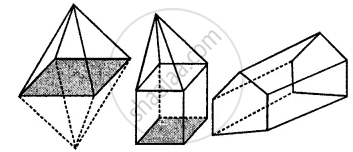
Using Euler's formula, find the values of x, y, z.
| Faces | Vertices | Edges | |
| (i) | x | 15 | 20 |
| (ii) | 6 | y | 8 |
| (iii) | 14 | 26 | z |
Look at the shapes given below and state which of these are polyhedra using Euler’s formula.

Look at the shapes given below and state which of these are polyhedra using Euler’s formula.

Look at the shapes given below and state which of these are polyhedra using Euler’s formula.

Look at the shapes given below and state which of these are polyhedra using Euler’s formula.

Using Euler’s formula, find the value of unknown x in the following table.
| Faces | 7 |
| Vertices | 10 |
| Edges | x |
Using Euler’s formula, find the value of unknown y in the following table.
| Faces | y |
| Vertices | 12 |
| Edges | 18 |
Can a polyhedron have V = F = 9 and E = 16? If yes, draw its figure.
Check whether a polyhedron can have V = 12, E = 6 and F = 8.
