Advertisements
Advertisements
प्रश्न
Read the following paragraph and answer the questions that follow.
| A parallel plate capacitor has two parallel plates which are separated by an insulating medium like air, mica, etc. When the plates are connected to the terminals of a battery, they get equal and opposite charges and an electric field is set up in between them. This electric field between the two plates depends upon the potential difference applied, the separation of the plates and nature of the medium between the plates. |
(i) The electric field between the plates of a parallel plate capacitor is E. Now the separation between the plates is doubled and simultaneously the applied potential difference between the plates is reduced to half of its initial value. The new value of the electric field between the plates will be ______.
- E
- 2E
- `E/4`
- `E/2`
(ii) A constant electric field is to be maintained between the two plates of a capacitor whose separation d changes with time. Which of the graphs correctly depict the potential difference (V) to be applied between the plates as a function of separation between the plates (d) to maintain the constant electric field?


(iii)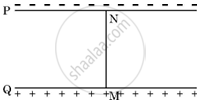
In the above figure P, Q are the two parallel plates of a capacitor. Plate Q is at positive potential with respect to plate P. MN is an imaginary line drawn perpendicular to the plates. Which of the graphs shows correctly the variations of the magnitude of electric field strength E along the line MN?


(iv) Three parallel plates are placed above each other with equal displacement `vec d` between neighbouring plates. The electric field between the first pair of the plates is `vec E_1` and the electric field between the second pair of the plates is `vec E_2`. The potential difference between the third and the first plate is ______.
- `(vec E_1 + vec E_2) * vec d`
- `(vec E_1 - vec E_2) * vec d`
- `(vec E_2 - vec E_1) * vec d`
- `(d(E_1 + E_2))/2`
OR
(iv) A material of dielectric constant K is filled in a parallel plate capacitor of capacitance C. The new value of its capacitance becomes ______.
- C
- `C/K`
- CK
- `C(1 + 1/K)`
Advertisements
उत्तर
(i) The electric field between the plates of a parallel plate capacitor is E. Now the separation between the plates is doubled and simultaneously the applied potential difference between the plates is reduced to half of its initial value. The new value of the electric field between the plates will be `bbunderline(E/4)`.
Explanation:
Electric field in a parallel plate capacitor:
The initial electric field (E) = `V/d`
If the plate separation doubles (2d) and the applied voltage is halved `(V/2)`, the new field is:
E' = `((V/2)/(2d))`
= `E/4`
∴ The new electric field is `E/4`.
(ii)

Explanation:
To maintain a constant electric field (E) between the plates of a capacitor, the potential difference (V) should be:
V = E.d
Since E is constant and d changes, V must be directly proportional to d. This means the graph of V vs. d should be a straight line passing through the origin with a positive slope.
(iii)
Explanation:
Between two capacitor plates, there is a constant electric field. If one plate is at a positive potential and the other at a lower potential, the electric field should remain constant between them. A constant value of E between the plates with no variation along MN should be presented on the proper graph.
(iv) Three parallel plates are placed above each other with equal displacement `vec d` between neighbouring plates. The electric field between the first pair of the plates is `vec E_1` and the electric field between the second pair of the plates is `vec E_2`. The potential difference between the third and the first plate is `bbunderline((vec E_1 + vec E_2) * vec d)`.
Explanation:
The potential difference (V) between two plates separated by a distance (d) in a uniform electric field `(vec E)` is given by:
V = `vec E* d`
Let the three plates be numbered 1, 2, and 3 from bottom to top.
For the first gap between plates 1 to 2 the distance is d, and the electric field is `vec E_1`.
The potential difference across this gap is:
V21 = `vec E_1 * d`
For the second gap between plates 2 to 3 the distance is d, and the electric field is `vec E_2`.
The potential difference across this gap is:
V32 = `vec E_2 * d`
To find the total potential difference between the third plate and the first plate (V31), add the potential differences of both consecutive gaps together:
V31 = V21 + V32
= `(vec E_1 . d) + (vec E_2 . d)`
= `(vec E_1 + vec E_2)d`
OR
(iv) A material of dielectric constant K is filled in a parallel plate capacitor of capacitance C. The new value of its capacitance becomes CK.
Explanation:
The standard capacitance (C) of a parallel-plate capacitor with air or a vacuum between its plates is expressed as:
C = `(epsilon_0 A)/d`
When a dielectric material with a dielectric constant (K) completely fills the space between the plates, the permittivity of the medium increases by a factor of K(ε = Kε0).
Substitute the new permittivity into the capacitance formula to find the updated capacitance (C').
C' = `(K epsilon_0 A)/d`
= `K * ((epsilon_0 A)/d)`
= CK
