Advertisements
Advertisements
प्रश्न
A monochromatic ray of light incident on one refracting surface of an equilateral prism, suffers a deviation as shown in the Figure 7 below:
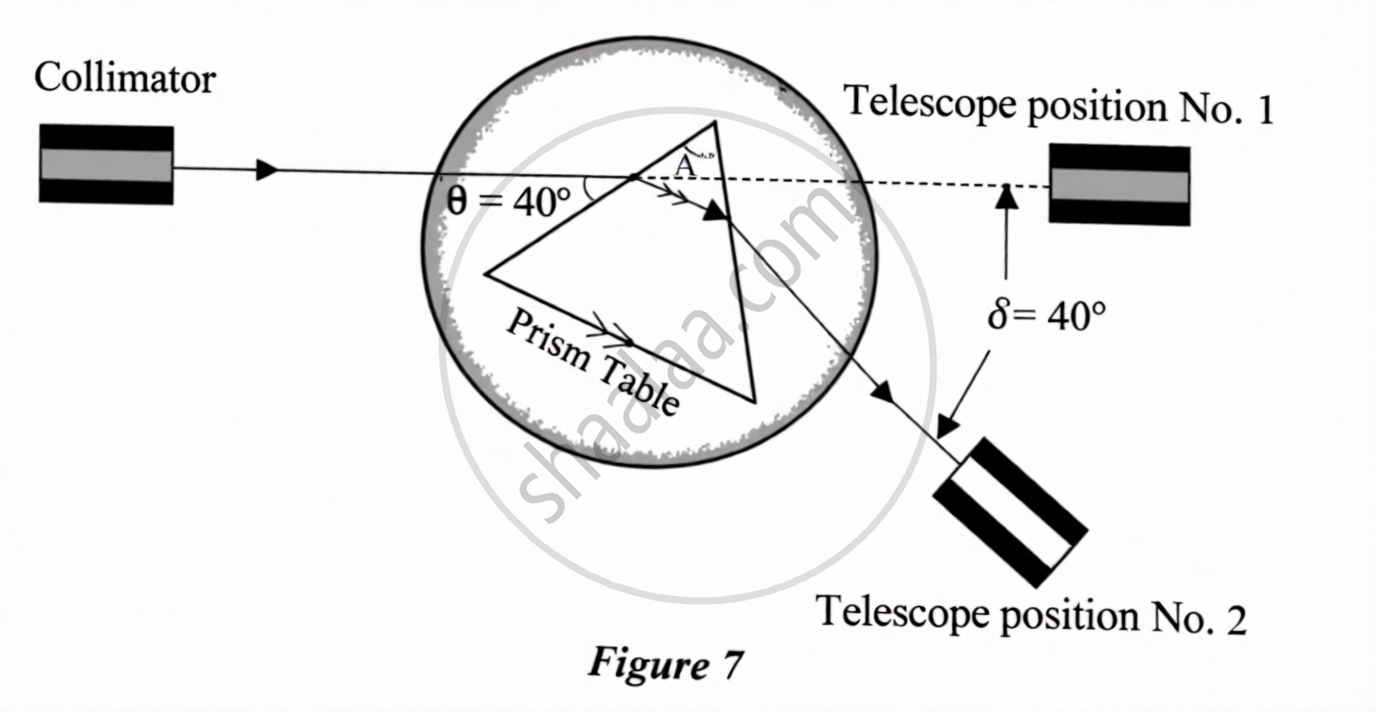
- Calculate the refractive index of the material of the prism.
- What is meant by dispersive power of a transparent material?
Advertisements
उत्तर
(i) Identify the angle of the prism (A). Since the problem states it is an equilateral prism, all internal angles are equal.
A = 60°
Determine the angle of Incidence (i). The diagram shows the glancing angle θ = 40°. In optics, the angle of incidence is measured from the normal to the surface.
i = 90° − 40°
= 50°
Analyze the deviation (δ). The diagram shows the angle of deviation δ = 40°. We can check if this is the minimum deviation by using the formula δ = i + e − A
40° = 50° + e − 60°
40° = e − 10°
e = 50°
Since the angle of incidence (i) equals the angle of emergence (e), the prism is in the position of minimum deviation (δm = 40°).
For a prism at minimum deviation, the refractive index n is:
n = `(sin(A + δ_m)/2)/(sin(A/2))`
= `(sin(60° + 40°)/2)/(sin(60°/2))`
= `(sin 50°)/(sin 30°)`
Using standard values (sin 50° = 0.766 and sin 30° = 0.5).
= `0.766/0.5`
= 1.532
(ii) Dispersive power (ω) is a measure of a material’s ability to spread out (disperse) different colours of light.
It is defined as the ratio of the angular dispersion (the difference in deviation between violet and red light) to the mean deviation (the deviation of yellow light).
ω = `(δ_v - δ_r)/(δ_y)`
Or, in terms of refractive indices:
ω = `(n_v - n_r)/(n_y - 1)`
