Advertisements
Advertisements
प्रश्न
A max X goes to the top of a building by a vertical spiral staircase. Another man Y of the same mass goes to the top of the same building by a slanting ladder. Which of the two does more work against gravity and why?
Advertisements
उत्तर
'X’ and ‘Y’ are two persons doing the same amount of work against gravity in climbing to the top of the building. Work done against gravity depends on the vertical distance through which the body is lifted and is independent of the path travelled to achieve that height. Both men travel the same distance vertically, so the work done by them against gravity is equal.
संबंधित प्रश्न
In which of the following cases is work being done:
- A boy pushing a heavy rock
- A boy climbing up the stairs
- A coolie standing with a box on his head
- A girl moving on the road.
A coolie is moving on a road with a luggage on his head. Does he perform work against the force of gravity? Give reason for your answer.
A box of weight 150 kgf has gravitational potential energy stored in it equal to 14700 J. Find the height of the box above the ground. (Take g = 9.8 N kg-1)
Find the kinetic energy of a body of mass 1 kg moving with a uniform velocity of 10 m s-1.
A car is running at a speed of 15 km h-1 while another similar car is moving at a speed of 45 km h-1. Find the ratio of their kinetic energies.
In which of the following case the work done by a force will be maximum : when the angle between the direction of force and direction of motion is 0° or 90°?
How much work is done by the gravitational force of earth acting on a satellite moving around it in a circular path? Give reason for your answer.
Each of the following statement describes a force acting. Which force is causing work to be done?
A girl weighing 400 N climbs a vertical ladder. If the value of g be 10 m s−2, the work by her after climbing 2 m will be :
What is meant by a translational motion? Give one example.
Is the motion of moon around the earth in circular path an accelerated motion?
Name the force acting away from the centre of circular path.
Complete the following sentences:
The SI unit of work is ....... and of power is .......
Complete the following sentences:
Kilowatt is the unit of ....... and kWh is the unit of
A boy of mass m climbs up a staircase of vertical height h.
- What is the work done by the boy against the force of gravity?
- What would have been the work done if he uses a lift in climbing the same vertical height?
State the energy changes which take place when Water stored in the dam is used to turn turbine in dynamo.
State the energy changes which take place when A toy car with a wound spring moves on ground.
A truck driver can load oil drums into the back of the truck by pushing them up a sloping plank, or by lifting them directly. Each drum has a mass of 80 kg, the plank is 3 m long, and the back of the truck is 0.8 m above the ground.
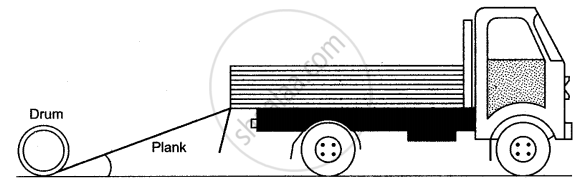
(i) How much force would be needed to lift a drum into the truck directly/without using the plank? (Take g = 10 m/s2)
(ii) How much energy would be required in lifting the drum into the truck without the plank?
(iii) If the force needed to push the drum up the plank is 300 N, why is this less than the answer to part (i)?
(iv) When the truck is loaded, the driver drives off. List the major energy changes that take place in moving the truck.
(v) The driver has to stop at the factory gates. What happens to the kinetic energy of the truck?
A man squatting on the ground gets straight up and stand. The force of reaction of ground on the man during the process is ______.
