Advertisements
Advertisements
प्रश्न
A manufacturer wishes to produce two commodities A and B. The number of units of material, labour and equipment needed to produce one unit of each commodity is shown in the table given below. Also shown is the available number of units of each item, material, labour, and equipment.
| Items | Commodity A | Commodity B | Available no. of Units |
| Material | 1 | 2 | 8 |
| Labour | 3 | 2 | 12 |
| Equipment | 1 | 1 | 10 |
Find the maximum profit if each unit of commodity A earns a profit of ₹ 2 and each unit of B earns a profit of ₹ 3.
Advertisements
उत्तर
Let x be the number of units commodity A produced and y be the number of units commodity B produced. The values of x and y must satisfy the following:
x + 2y ≤ 8 (material constraint) .........(i)
3x + 2y ≤ 12 (labour constraint) ........(ii)
x + y ≤ 10 (equipment constraint) .......(iii)
Also, x ≥ 0, y ≥ 0
Let Z be the profit, then
Z = 2x + 3y
Plotting the graph using these constraints:
From equation (i),
x + 2y = 8
| x | 8 | 0 |
| y | 0 | 4 |
From equation (ii),
3x + 2y = 12
| x | 4 | 0 |
| y | 0 | 6 |
From equation (iii),
x + y = 10
| x | 10 | 0 |
| y | 0 | 10 |
Clearly, the coordinates of the vertices of shade region OABC are O(0, 0), A(4, 0), B(2, 3) and C(0, 4).
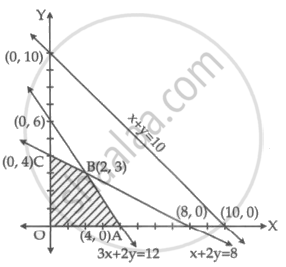
Now we can determine the value of Z by evaluating Z at these four points:
| Vertices | Z = 2x + 3y |
| O(0, 0) | 0 |
| A(4, 0) | 8 |
| B(2, 3) | 13 (max) |
| C(0, 4) | 12 |
So, the maximum profit is ₹ 13.
