Advertisements
Advertisements
प्रश्न
A linear programming problem is given by Z = px + qy, where p, q > 0 subject to the constraints x + y ≤ 60, 5x + y ≤ 100, x ≥ 0 and y ≥ 0.
- Solve graphically to find the corner points of the feasible region.
- If Z = px + qy is maximum at (0, 60) and (10, 50), find the relation of p and q. Also mention the number of optimal solution(s) in this case.
Advertisements
उत्तर
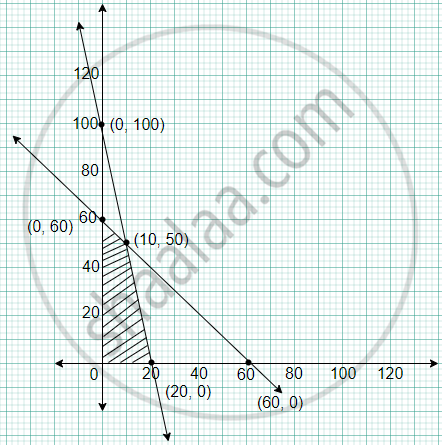
i. From the graph, the two boundary lines are:
Line 1 passes through (0, 60) and (60, 0):
`x/60 + y/60 = 1`
x + y = 60
Line 2 passes through (0, 100) and (20, 0):
`x/20 + y/100 = 1`
5x + y = 100
Since the feasible region lies in the first quadrant:
x ≥ 0, y ≥ 0, x + y ≤ 60, 5x + y ≤ 100
Corner points:
1. Intersection of x = 0 and x + y = 60:
y = 60
⇒ A(0, 60)
2. Intersection of x + y = 60 and 5x + y = 100:
x + y = 60 ...(1)
5x + y = 100 ...(2)
Subtracting (1) from (2):
4x = 40
⇒ x = 10
y = 60 − 10 = 50
⇒ B(10, 50)
3. Intersection of y = 0 and 5x + y = 100:
5x = 100
⇒ x = 20
⇒ C(20, 0)
4. Intersection of the axes:
D(0, 0)
∴ Corner points are A(0, 60), B(10, 50), C(20, 0), D(0, 0)
ii. Z = px + qy
Given that Z is maximum at both corner points (0, 60) and (10, 50). So the value of Z at these two points must be equal.
At (0, 60):
Z = p(0) + q(60) = 60q
At (10, 50):
Z = p(10) + q(50) = 10p + 50q
Since both give maximum,
60q = 10p + 50q
60q − 50q = 10p
10q = 10p
p = q
Since the objective function line is parallel to the boundary segment joining (0, 60) and (10, 50), the maximum value of Z occurs at every point on that segment.
∴ p = q and there are infinitely many optimal solutions.
