Advertisements
Advertisements
प्रश्न
A hemispherical depression is cut out from one face of a cubical wooden block such that the diameter a of the hemisphere is equal to the edge of the cube. Determine the surface area of the remaining solid.
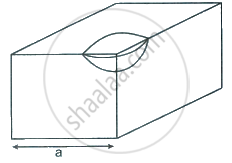
योग
Advertisements
उत्तर
Let the edge of the cube = a.
The diameter of the hemispherical depression is equal to the edge of the cube.
= r = `a/2`
1) Total surface area of the cube
`TSA _"cube" = 6a^2`
2) Area removed from one face of the cube
A circular portion is cut out.
Area of circle = `πr^2`
= `π(a/2)^2`
= `(πa^2)/4`
3) Curved surface area of the hemispherical depression (added)
CSA of hemisphere = 2πr2
= `2π(a/2)^2`
= `(πa^2)/2`
Surface area of the remaining solid
`6a^2 − (πa^2)/4 + (πa^2)/2`
= `6a^2 + (πa^2)/4`
Surface Area = `(a^2(24 + π))/4` square units`
shaalaa.com
क्या इस प्रश्न या उत्तर में कोई त्रुटि है?
