Advertisements
Advertisements
प्रश्न
|
A flagstaff, 7.32 m long is fitted at the top of 10 m tall building. The flagstaff is supported by the ropes which are tied to the point P on the ground which is x m away from the base of the building. It is given that `l_1` is the length of rope from point P to the base of the flagstaff and `l_2` is the length of rope from point P to the top of flagstaff. Rope `l_1` makes an angle of 30° with the horizontal and θ be the angle which rope `l_2` makes with the horizontal as shown in the figure.
|
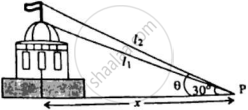
Based on the given information, answer the following questions:
(Use `sqrt(2) = 1.4` and `sqrt(3) = 1.732`)
(i) Find the value of x. [1]
(ii) Find the measure of angle θ. [1]
(iii) (a) Find the total length of ropes needed to support the flagstaff. [2]
OR
(iii) (b) Which rope is longer `l_1` or `l_2` and by how much? [2]
Advertisements
उत्तर
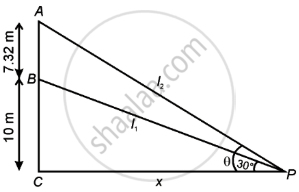
(i) In ΔBCP,
`tan 30^circ = (BC)/(CP)`
`1/sqrt(3) = 10/x`
∴ `x = 10sqrt(3)`
x = 10 × 1.732
x = 17.32 m
(ii) In ΔACP,
`tan θ = (AC)/(CP)`
= `(AB + BC)/x`
= `(7.32 + 10)/(17.32)`
tan θ = 1
∴ θ = 45°
(iii) (a) `sin 30^circ = 10/(l_1)`
`1/2 = 10/(l_1)`
`l_1` = 20 m
`l_2 = sqrt((17.32)^2 + (17.32)^2)`
= `17.32sqrt(2)`
= 17.32 × 1.4
`l_2` = 24.248 m
Required length `l_1 + l_2` = 20 m + 24.248 m
= 44.248 m
= 44.25 m
OR
(iii) (b) ∴ `l_2 - l_1` = 24.25 – 20
= 4.25 m
∴ `l_2` is larger by 4.25 m
