Advertisements
Advertisements
प्रश्न
A double convex lens with refractive index μ1 inside two liquids of refractive indices μ2 and μ3 are shown in the diagrams below. The refractive indices are such that μ2 > μ1 and μ1 > μ3.
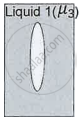 |
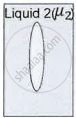 |
| Figure a | Figure b |
How would a parallel incident beam of light refract when it comes out of the lens in each of the cases shown above?
- in Fig a.
- in Figure b.
Advertisements
उत्तर
According to the lens maker formula:
`1/f ∝ ("refractive index of 2nd medium"/"refractive index of 1st medium" - 1)` .....(i)
1. In figure a:
Refractive index of 1st medium = μ3
Refractive index of 2nd medium = μ1
Then, from relation (i)
`1/f ∝ (μ_1/μ_3 - 1)`
As, μ1 > μ3
⇒ `μ_1/μ_3 > 1`
⇒ `1/f > 0`
⇒ f > 0
Since the resulting focal length is positive so this lens behaves as a converging lens.
Hence, a parallel incident beam of light converges when it comes out of the lens im figure a.
2. In figure b:
Refractive index of 1st medium = μ2
Refractive index of 2nd medium = μ1
Then, from relation (i)
`1/f ∝ (μ_1/μ_2 - 1)`
As, μ1 < μ2
⇒ `μ_1/μ_2 < 1`
⇒ `1/f < 0`
⇒ f < 0
Since the resulting focal length is negative, this lens behaves as a diverging lens.
Hence, a parallel incident beam of light diverges when it comes out of the lens in figure b.
