Advertisements
Advertisements
प्रश्न
A cube of side 5 cm is cut into as many 1 cm cubes as possible. What is the ratio of the surface area of the original cube to that of the sum of the surface areas of the smaller cubes?
Advertisements
उत्तर
Surface area of a cube = 6a2, where a is side of a cube.
... Side of cube = 5 cm
... Surface area of the cube = 6 × (5)2 = 6 × 25 = 150 cm2
Now, surface area of the cube with side 1 cm = 6 × (1)2 = 6 cm2
... Surface area of 5 cubes with side 1 cm = 5 × 6 = 30 cm2
Ratio of the surface area of the original cube to that of the sum of the surface area of the smaller cubes
= `30/150`
= `3/15`
= 1 : 5
APPEARS IN
संबंधित प्रश्न
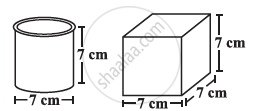
Describe how the two figures at the right are alike and how they are different. Which box has larger lateral surface area?
Find the volume in cubic decimetre of the cube whose side is 1.5 m.
Fill in the blank in the following so as to make the statement true:
1 kl = ........ cu. dm = ........ cu. cm.
Find the surface area of a cube whose edge is 3 cm.
Cubes A, B, C having edges 18 cm, 24 cm and 30 cm respectively are melted and moulded into a new cube D. Find the edge of the bigger cube D.
The dimensions of a solid metallic cuboid are 72 cm × 30 cm × 75 cm. It is melted and recast into identical solid metal cubes with each edge 6 cm. Find the number of cubes formed.
Also, find the cost of polishing the surfaces of all the cubes formed at the rate Rs. 150 per sq. m.
Find the volume of a cube whose diagonals is `sqrt(48)"cm"`.
Three equal cubes are placed adjacently in a row. Find the ratio of the total surface area of the resulting cuboid to that of the sum of the total surface areas of the three cubes.
If the lateral surface area of a cube is 600 cm2, then the total surface area is
A cube of side 4 cm is cut into 1 cm cubes. What is the ratio of the surface areas of the original cubes and cut-out cubes?
