Advertisements
Advertisements
प्रश्न
|
A city’s traffic management department is planning to optimize traffic flow by analyzing the connectivity between various traffic signals. The city has five major spots labelled A, B, C, D, and E.
|
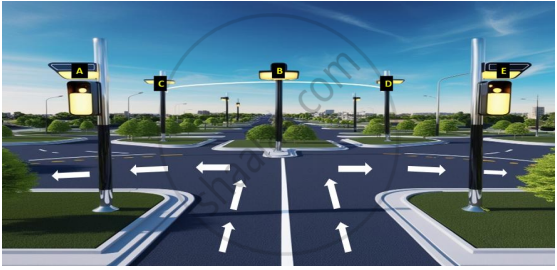
The department wants to represent and analyze this data using relations and functions. Use the given data to answer the following questions:
- Is the traffic flow reflexive? Justify. (1)
- Is the traffic flow transitive? Justify. (1)
-
- Represent the relation describing the traffic flow as a set of ordered pairs. Also state the domain and range of the relation. (2)
OR - Does the traffic flow represent a function? Justify your answer.
- Represent the relation describing the traffic flow as a set of ordered pairs. Also state the domain and range of the relation. (2)
Advertisements
उत्तर
Traffic flow is a relation which looks like
R = {(A, B), (A, C), (A, D), (B, C), (B, E), (C, E), (D, E), (D, C)}
I. If the relation is reflexive, then (x, x) ∈ R for every x ∈ A, i.e., (A, B, C, D, E)
Since (A, A) ∉ R
∴ R is not reflexive.
II. If (x, y) ∈ R and (y, z) ∈ R, then (x, z) ∈ R
Here, (A, C) ∈ R and (C, E) ∈ R but (A, E) ∉ R.
∴ R is not transitive.
III. A.
Domain = Set of all first elements of ordered pair
= {A, B, C, D}
Range = Set of all second elements of ordered pair
= {B, C, D, E}
OR
III. B. Function is a special type of relation where
- Every element will have an image.
- Every element will have only one image
Now, R = {(A, B), (A, C), (A, D), (B, C), (B, E), (C, E), (D, E), (D, C)}
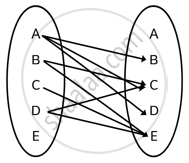
Here, A has 3 images, B has 2 images, D has 2 images and E has no images.
Thus, the traffic flow is not a function.
