Advertisements
Advertisements
प्रश्न
A charge is distributed uniformly over a ring of radius 'a'. Obtain an expression for the electric intensity E at a point on the axis of the ring. Hence, show that for points at large distance from the ring, it behaves like a point charge.
Advertisements
उत्तर
Here, we have a ring of radius a that carries a uniformly distributed positive total charge Q.
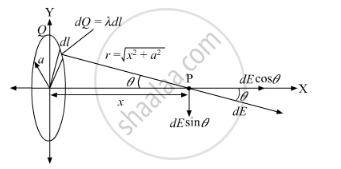
We have to calculate the electric field due to a ring at a point P lying a distance x from its centre along the central axis perpendicular to the plane of the ring.
As the charge is distributed uniformly over the ring, the charge density over the ring can be written as follows:
`lambda=Q/(2pia)`
Along the x-axis, the perpendicular components of the electric fields due to charge on the ring cancel each other out.
As there is same charge on both sides of the ring, the magnitude of the electric field at P due to the segment of charge dQ is given by
`dE=k_e (dQ)/r^2`
`E_x= int_"ring"k(dQ)/r^2costheta`
`=int_0^(2pia) k (lambdadl)/r^2 x/r`
`=klambda x/r^3 int_0^(2pia) dl`
`=klambda x/r^3 2pia`
`=kQ/(2pia)x/r^3 2pia`
`=KQx/r^3=KQ x/sqrt((x^2+a^2))^3`
1. At the centre of the ring, the electric field is zero as x = 0.
2. When x >> a , a can be neglected in the denominator compared to x, and the loop looks like a point charge at large distances.
`E=kQ x/sqrt((x^2+a^2)^3)`
`E=kQ/x^2, ("at "x" >> "a)`
संबंधित प्रश्न
What is the amount of work done in moving a point charge Q around a circular arc of radius ‘r’ at the centre of which another point charge ‘q’ is located?
What is the function of uniform radial field and how is it produced?
Why must electrostatic field at the surface of a charged conductor be normal to the surface at every point? Give reason?
The bob of a simple pendulum has a mass of 40 g and a positive charge of 4.0 × 10⁻⁶ C. It makes 20 oscillations in 45 s. A vertical electric field pointing upward and of magnitude 2.5 × 10⁴ NC−1 is switched on. How much time will it now take to complete 20 oscillations?
A charged oil drop weighing 1.6 x 10⁻¹⁵ N is found to remain suspended in a uniform electric field of intensity 2 x 10³ Nc-1. Find the charge on the drop.
A particle of charge q and mass m moves rectilinearly under the action of electric field E = A – Bx, where A and B are positive constants and x is distance from the point where particle was initially at rest then the distance traveled by the particle before coming to rest and acceleration of particle at that moment are respectively.
A charge Q is placed at the centre of the line joining two point charges +q and +q as shown in the figure. The ratio of charges Q and q is ______.

Electric lines of force about negative point charge are ______
Consider two identical point charges located at points (0, 0) and (a, 0).
Is there a point on the line joining them at which the electric field is zero?
In case of an infinite line charge, how does intensity of electric field at a point change, if at all, when.
- charge on it is doubled?
- distance of the point is halved?
