Advertisements
Advertisements
प्रश्न
A beam 5 m long and 40 cm wide contains 0.6 cubic metre of wood. How thick is the beam?
Advertisements
उत्तर
\[\text { Length of the beam = 5m }\]
\[\text { Breadth = 40 cm }\]
\[ = 40 \times \frac{1}{100}m ( \because 100 cm = 1 m)\]
\[ = 0 . 4 m\]
\[\text { Suppose that the height of the beam is h m }. \]
\[\text { Also, it is given that the beam contains 0 . 6 cubic metre of wood }. \]
\[\text { i . e . , volume of the beam = 0 . 6 }m^3 \]
\[\text { Now, volume of the cuboidal beam = length } \times \text { breadth }\times\text { height}\]
\[ \Rightarrow 0 . 6 = 5 \times 0 . 4 \times h\]
\[ \Rightarrow 0 . 6 = 2 \times h\]
\[ \Rightarrow h = \frac{0 . 6}{2} = 0 . 3 m\]
\[ \therefore \text { The beam is 0 . 3 m thick } .\]
संबंधित प्रश्न
Describe how the two figures at the right are alike and how they are different. Which box has larger lateral surface area?
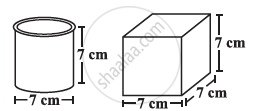
Fill in the blank in the following so as to make the statement true:
1 kl = ....... m3
Find the surface area of a cube whose edge is 6 m .
Four identical cubes are joined end to end to form a cuboid. If the total surface area of the resulting cuboid as 648 m2; find the length of the edge of each cube. Also, find the ratio between the surface area of the resulting cuboid and the surface area of a cube.
The edges of three solid cubes are 6 cm, 8 cm, and 10 cm. These cubes are melted and recast into a single cube. Find the edge of the resulting cube.
The volume of a cube is 1331 cm3. Find its total surface area.
A cuboid is 25cm long, 15cm board and 9cm high. Find the whole surface of a cube having its volume equal to that of the cuboid.
The base of a rectangular container is a square of side 12 cm. This container holds water up to 2 cm from the top. When a cube is placed in the water and is completely submerged, the water rises to the top and 224 cm3 of water overflows. Find the volume and surface area of the cube.
If the lateral surface area of a cube is 600 cm2, then the total surface area is
A river 2 m deep and 45 m wide is flowing at the rate of 3 km per hour. Find the amount of water in cubic metres that runs into the sea per minute.
