Topics
Introduction to Microprocessors and Organization of 8085
Instruction Set and Programming of 8085
- Introduction to Set and Programming of 8085
- Instruction Cycle
- Addressing Modes
- Programming model of 8085
- Introduction to Classification of 8085
- How to Write and Execute Simple Assembly Language Program ?
- Data Transfer Instruction
- Arithmetic Group Instructions
- Logical Group Instructions
- Branching Group Instructions
- Machine Control Instruction
Introdcution to Intel X-86 Family
Introduction to Microcontroller
Networking Technology
Introduction to Advanced Microprocessors
The evolution from 4-bit to 32-bit microprocessors brought significant advancements, though the shift from 16-bit to 32-bit didn't introduce a completely new architecture. Advanced 32-bit microprocessors, often paired with numeric coprocessors for faster arithmetic operations, are powerful computing devices used in general-purpose computers and graphic systems. These systems require sophisticated operating systems and applications, supporting multiuser and multitasking environments, where the CPU can handle multiple users or tasks simultaneously by switching between software efficiently.
Priviliged levels for multiuser or multitasking operating system
The advanced microprocessors offer a special way of operating which is called the supervisory, protected or privileged mode. When microprocessor is operated in this mode, it may have access to a number of special instructions, additional registers and other features.
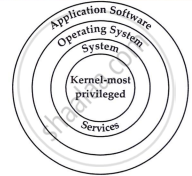
Data protection techniques are used to keep two users or tasks from accessing the same data at the same time.
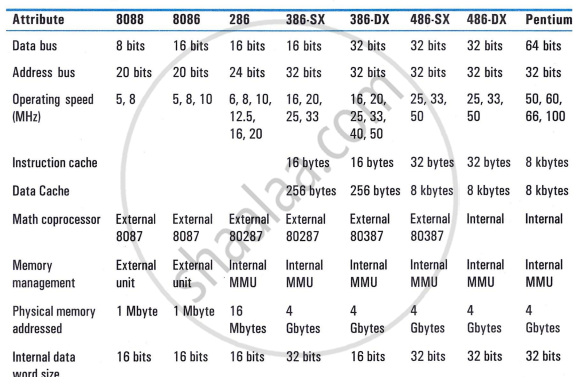
Study of major attributes of X- 86 family
This fig represents the major points of differences between various microprocessor of X-86 family.
INTEL 8086/8088
The 8086 microprocessor is a 16-bit chip housed in a 40-pin DIP package, capable of addressing 1 MB of memory with its 20-bit address bus. It operates at clock frequencies between 5 MHz and 10 MHz and has an 8-bit external data bus. The 8086 is like the 8088 in internal architecture, with differences in external design. It shares power and clock signals with the 8085 processor, supports multiprocessor environments, and multiplexes data and status signals with the address bus, using 16 multiplexed data lines (AD15-AD0).
INTEL 80286
The Intel 80286 is a 16-bit microprocessor, an extended version of the 8086, introduced in the IBM PC/AT in 1984. It supports 24-bit addressing for 16MB of memory and features real and protected modes, enabling up to 1GB of virtual memory and hardware multitasking. It also includes mechanisms for memory protection and multiuser support.
INTEL 80386
The Intel 80386 is a 32-bit microprocessor, an advanced version of the 80286, featuring a 32-bit data and address bus, capable of addressing up to 4GB of memory. It operates at clock frequencies between 16MHz and 33MHz, with highly pipelined instruction execution, making it suitable for multiuser and multitasking environments. The architecture is similar to earlier models but with enhanced 32-bit registers. Intel introduced the 386SX variant with a 16-bit data bus for compatibility with existing 16-bit peripherals. The 80386DX, DX2, and DX4 versions offer improved virtual memory, protected mode, and increased processing speeds by doubling or tripling the internal clock.
INTEL 80486
The Intel 80486 is an upgraded, faster version of the 80386, featuring a 32-bit processor with a built-in math coprocessor, memory management unit (MMU), and 8KB of on-chip cache memory. It operates with clock frequencies from 25MHz to 66MHz and contains 1.2 million transistors, significantly more than 386. The 80486 achieves high-speed operation through its pipelined architecture, RISC-based microcode, and reduced instruction execution time to one clock period for many instructions. Available in DX and SX versions, the SX lacks the on-chip math coprocessor. The 80486 is designed for high-end microcomputers, supporting multiuser and multiprocessing systems.
