Advertisements
Advertisements
Question
Draw a neat, labelled energy level diagram for H atom showing the transitions. Explain the series of spectral lines for H atom, whose fixed inner orbit numbers are 3 and 4 respectively.
Advertisements
Solution
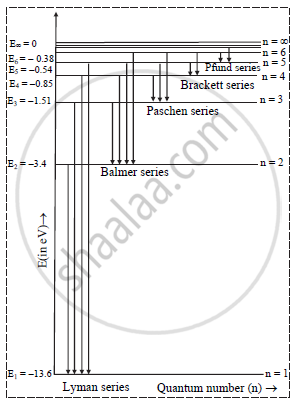
Paschen series:
i. The spectral lines of this series correspond to the transition of an electron from some higher energy state to 3rd orbit.
ii. For paschen series, p = 3 and n = 4, 5,...
The wave numbers and the wavelengths of the spectral lines constituting the Paschen series are given by,
`barv=1/lambda=R(1/3^2-1/n^2)`
iii. Paschen series lies in the infrared region of the spectrum which is invisible and contains infinite number of lines.
iv. Wavelengths for n = 4 and 5 are 18750 Å and 12820 Å respectively.
Brackett series:
i. The spectral lines of this series corresponds to the transition of an electron from a higher energy state to the 4th orbit.
ii. For this series, p = 4 and n = 5, 6, 7,...
The wave numbers and the wavelengths of the spectral lines constituting the Brackett series are given by,
`barv=1/lambda=R(1/4^2-1/n^2)`
iii. This series lies in the ne ar infrared region of the spectrum and contains infinite number of lines. Wavelengths for n = 5 and 6, are 40518 Å and 26253 Å respectively
APPEARS IN
RELATED QUESTIONS
(i) State Bohr's quantization condition for defining stationary orbits. How does the de Broglie hypothesis explain the stationary orbits?
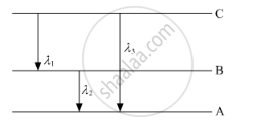
(ii) Find the relation between three wavelengths λ1, λ2 and λ3 from the energy-level diagram shown below.
Find the frequency of revolution of an electron in Bohr’s 2nd orbit; if the radius and speed of electron in that orbit is 2.14 × 10⁻¹⁰ m and 1.09 × 10⁶ m/s respectively. [π= 3.142]
Show that the circumference of the Bohr orbit for the hydrogen atom is an integral multiple of the de Broglie wavelength associated with the electron revolving around the orbit.
The longest wavelength doublet absorption transition is observed at 589 and 589.6 nm. Calculate the frequency of each transition and energy difference between two excited states.
- Using the Bohr’s model, calculate the speed of the electron in a hydrogen atom in the n = 1, 2 and 3 levels.
- Calculate the orbital period in each of these levels.
State Bohr postulate of hydrogen atom that gives the relationship for the frequency of emitted photon in a transition.
In a laser tube, all the photons
A beam of light having wavelengths distributed uniformly between 450 nm to 550 nm passes through a sample of hydrogen gas. Which wavelength will have the least intensity in the transmitted beam?
The earth revolves round the sun due to gravitational attraction. Suppose that the sun and the earth are point particles with their existing masses and that Bohr's quantization rule for angular momentum is valid in the case of gravitation. (a) Calculate the minimum radius the earth can have for its orbit. (b) What is the value of the principal quantum number n for the present radius? Mass of the earth = 6.0 × 10⁻²⁴ kg. Mass of the sun = 2.0 × 1030 kg, earth-sun distance = 1.5 × 10¹¹ m.
Obtain Bohr’s quantisation condition for angular momentum of electron orbiting in nth orbit in hydrogen atom on the basis of the wave picture of an electron using de Broglie hypothesis.
Calculate angular momentum of an electron in the third Bohr orbit of a hydrogen atom.
The energy associated with the first orbit of He+ is ____________ J.
In Bohr model of hydrogen atom, which of the following is quantised?
When an electric discharge is passed through hydrogen gas, the hydrogen molecules dissociate to produce excited hydrogen atoms. These excited atoms emit electromagnetic radiation of discrete frequencies which can be given by the general formula
`bar(v) = 109677 1/n_1^2 - 1/n_f^2`
What points of Bohr’s model of an atom can be used to arrive at this formula? Based on these points derive the above formula giving description of each step and each term.
Why was a change in the Bohr Model of atom required? Due to which important development (s), concept of movement of an electron in an orbit was replaced by, the concept of probability of finding electron in an orbital? What is the name given to the changed model of atom?
On the basis of Bohr's model, the approximate radius of Li++ ion in its ground state ifthe Bohr radius is a0 = 53 pm :
A set of atoms in an excited state decays ______.
How will the energy of a hydrogen atom change if n increases from 1 to ∞?
Given below are two statements:
Statements I: According to Bohr's model of an atom, qualitatively the magnitude of velocity of electron increases with decrease in positive charges on the nucleus as there is no strong hold on the electron by the nucleus.
Statement II: According to Bohr's model of an atom, qualitatively the magnitude of velocity of electron increase with a decrease in principal quantum number.
In light of the above statements, choose the most appropriate answer from the options given below:
The value of angular momentum for He+ ion in the first Bohr orbit is ______.
According to Bohr atom model, in which of the following transitions will the frequency be maximum?
The first ionization energy of H is 21.79 × 10⁻¹⁹ J. The second ionization energy of He atom is ______ × 10-19J.
In hydrogen atom, transition from the state n = 6 to n = 1 results in ultraviolet radiation. Infrared radiation will be obtained in the transition ______.
A 20% efficient bulb emits light of wavelength 4000 Å. If the power of the bulb is 1 W, the number of photons emitted per second is ______.
[Take, h = 6.6 × 10⁻³⁴ J-s]
Calculate the radius of the second orbit of He+.
