Advertisements
Chapters
![Samacheer Kalvi solutions for Mathematics [English] Class 9 TN Board chapter 1 - Set Language - Shaalaa.com](/images/mathematics-english-class-9-tn-board_6:5f2b1b2038084cf381bfa42c826a928c.jpg "Samacheer Kalvi solutions for Mathematics [English] Class 9 TN Board chapter 1 - Set Language")
Advertisements
Solutions for Chapter 1: Set Language
Below listed, you can find solutions for Chapter 1 of Tamil Nadu Board of Secondary Education Samacheer Kalvi for Mathematics [English] Class 9 TN Board.
Samacheer Kalvi solutions for Mathematics [English] Class 9 TN Board 1 Set Language Exercise 1.1 [Pages 5 - 6]
Identify the following is set?
The collection of prime numbers upto 100.
Identify the following is set?
The collection of rich people in India.
Identify the following is set?
The Collection of all rivers in India.
Identify the following is set?
The Collection of good Hockey players.
List the set of letters of the following words in Roster form.
INDIA
List the set of letters of the following words in Roster form.
PARALLELOGRAM
List the set of letters of the following words in Roster form.
MISSISSIPPI
List the set of letters of the following words in Roster form.
CZECHOSLOVAKIA
State whether True or False:
Consider the following sets A = {0, 3, 5, 8}, B = {2, 4, 6, 10} and C = {12, 14, 18, 20}.
18 ∈ C
True
False
Consider the following sets A = {0, 3, 5, 8}, B = {2, 4, 6, 10} and C = {12, 14, 18, 20}.
6 ∉ A
True
False
Consider the following sets A = {0, 3, 5, 8}, B = {2, 4, 6, 10} and C = {12, 14, 18, 20}
14 ∉ C
True
False
Consider the following sets A = {0, 3, 5, 8}, B = {2, 4, 6, 10} and C = {12, 14, 18, 20}
10 ∈ B
True
False
Consider the following sets A = {0, 3, 5, 8}, B = {2, 4, 6, 10} and C = {12, 14, 18, 20}
5 ∈ B
True
False
Consider the following sets A = {0, 3, 5, 8}, B = {2, 4, 6, 10} and C = {12, 14, 18, 20}
0 ∈ B
True
False
Fill in the blanks:
Consider the following sets A = {0, 3, 5, 8}, B = {2, 4, 6, 10} and C = {12, 14, 18, 20}
3 ∈ ____
Consider the following sets A = {0, 3, 5, 8}, B = {2, 4, 6, 10} and C = {12, 14, 18, 20}
14 ∈ ____
Consider the following sets A = {0, 3, 5, 8}, B = {2, 4, 6, 10} and C = {12, 14, 18, 20}
18 ____ B
Consider the following sets A = {0, 3, 5, 8}, B = {2, 4, 6, 10} and C = {12, 14, 18, 20}
4 ____ B
Represent the following set in Roster form
A = The set of all even natural numbers less than 20
Represent the following set in Roster form
B = `{y : y 1/(2"n"), "n"∈"N", "n" ≤ 5}`
Represent the following set in Roster form
C = {x : x is perfect cube, 27 < x < 216}
Represent the following set in Roster form
D = {x : x ∈ Z, −5 < x ≤ 2}
Represent the following set in set builder form
B = The set of all Cricket players in India who scored double centuries in One Day Internationals.
Represent the following set in set builder form
C = `{1/2, 2/3, 3/4, ...}`
Represent the following set in set builder form
D = The set of all tamil months in a year.
Represent the following set in set builder form
E = The set of odd Whole numbers less than 9.
Represent the following set in descriptive form
P = {January, June, July}
Represent the following set in descriptive form
Q = {7, 11, 13, 17, 19, 23, 29}
Represent the following set in descriptive form
R = {x : x ∈ N, x < 5}
Represent the following set in descriptive form
S = {x : x is a consonant in English alphabets}
Samacheer Kalvi solutions for Mathematics [English] Class 9 TN Board 1 Set Language Exercise 1.2 [Pages 11 - 12]
Find the cardinal number of the following set.
M = {p, q, r, s, t, u}
Find the cardinal number of the following set.
P = {x : x = 3n + 2, n ∈ W and x < 15}
Find the cardinal number of the following set.
Q = `{y : y = 4/(3"n"), "n" ∈ "N" and 2 < "n" ≤ 5}`
Find the cardinal number of the following set.
R = {x : x is an integer, x ∈ Z and – 5 ≤ x < 5}
Find the cardinal number of the following set.
S = The set of all leap years between 1882 and 1906.
Identify the following set as finite or infinite
X = The set of all districts in Tamilnadu
Identify the following set as finite or infinite
Y = The set of all straight lines passing through a point
Identify the following set as finite or infinite
A = {x : x ∈ Z and x < 5}
Identify the following set as finite or infinite
B = {x : x² – 5x + 6 = 0, x ∈ N}
Identify the following sets are equivalent or unequal or equal sets?
A = The set of vowels in the English alphabets.
B = The set of all letters in the word “VOWEL”
Identify the following sets are equivalent or unequal or equal sets?
C = {2, 3, 4, 5}
D = {x : x ∈ W, 1 < x < 5}
Identify the following sets are equivalent or unequal or equal sets?
X = {x : x is a letter in the word “LIFE”}
Y = {F, I, L, E}
Identify the following sets are equivalent or unequal or equal sets?
G = {x : x is a prime number and 3 < x < 23}
H = {x : x is a divisor of 18}
Identify the following set as null set or singleton set
A = {x : x ∈ N, 1 < x < 2}
Identify the following set as null set or singleton set
B = The set of all even natural numbers which are not divisible by 2
Identify the following set as null set or singleton set
C = {0}
Identify the following set as null set or singleton set
D = The set of all triangles having four sides
Identify the pair of sets are disjoint or overlapping?
A = {f, i, a, s} and B = {a, n, f, h, s}
Identify the pair of sets are disjoint or overlapping?
C = {x : x is a prime number, x > 2} and D = {x : x is an even prime number}
Identify the pair of sets are disjoint or overlapping?
E = {x : x is a factor of 24} and F = {x : x is a multiple of 3, x < 30}
If S = {square, rectangle, circle, rhombus, triangle}. List the elements of the following subset of S
The set of shapes which have 4 equal sides
If S = {square, rectangle, circle, rhombus, triangle}. List the elements of the following subset of S
The set of shapes which have radius
If S = {square, rectangle, circle, rhombus, triangle}. List the elements of the following subset of S
The set of shapes in which the sum of all interior angles is 180°
If S = {square, rectangle, circle, rhombus, triangle}. List the elements of the following subset of S
The set of shapes which have 5 sides
If A = {a, {a, b}}, write all the subsets of A.
Write down the power set of the following set:
A = {a, b}
Write down the power set of the following set:
B = {1, 2, 3}
Write down the power set of the following set:
D = {p, q, r, s}
Write down the power set of the following set:
E = Ø
Find the number of subsets and the number of proper subsets of the following set
W = {red, blue, yellow}
Find the number of subsets and the number of proper subsets of the following set
X = {x² : x ∈ N, x² ≤ 100}
If n(A) = 4, find n[P(A)]
If n(A) = 0, find n[P(A)]
If n[P(A)] = 256, find n(A)
Samacheer Kalvi solutions for Mathematics [English] Class 9 TN Board 1 Set Language Exercise 1.3 [Pages 18 - 19]
Using the given Venn diagram, write the element of A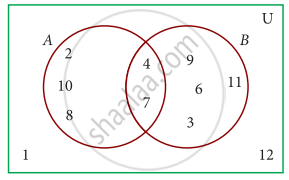
Using the given Venn diagram, write the element of B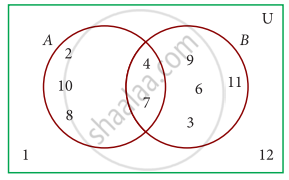
Using the given Venn diagram, write the element of A ∪ B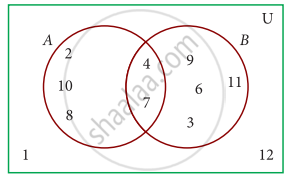
Using the given Venn diagram, write the element of A ∩ B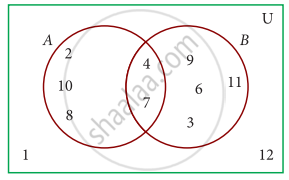
Using the given Venn diagram, write the element of A – B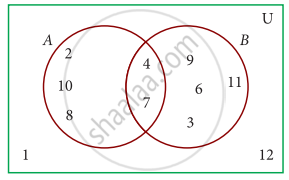
Using the given Venn diagram, write the element of B – A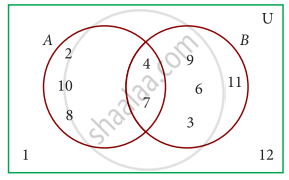
Using the given Venn diagram, write the element of A’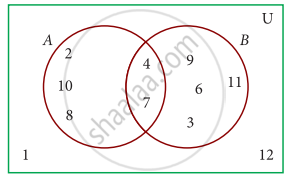
Using the given Venn diagram, write the element of B’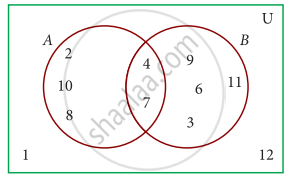
Using the given Venn diagram, write the element of U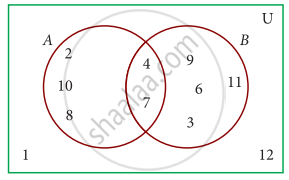
Find A ∪ B, A ∩ B, A – B and B – A for the following sets
A = {2, 6, 10, 14} and B = {2, 5, 14, 16}
Find A ∪ B, A ∩ B, A – B and B – A for the following sets
A = {a, b, c, e, u} and B = {a, e, i, o, u}
Find A ∪ B, A ∩ B, A – B and B – A for the following sets
A = {x : x ∈ N, x ≤ 10} and B = {x : x ∈ W, x < 6}
Find A ∪ B, A ∩ B, A – B and B – A for the following set.
A = Set of all letters in the word “mathematics” and
B = Set of all letters in the word “geometry”
If U = {a, b, c, d, e, f, g, h}, A = {b, d, f, h} and B = {a, d, e, h}, find the following set
A’
If U = {a, b, c, d, e, f, g, h}, A = {b, d, f, h} and B = {a, d, e, h}, find the following set
B’
If U = {a, b, c, d, e, f, g, h}, A = {b, d, f, h} and B = {a, d, e, h}, find the following set
A’ ∪ B’
If U = {a, b, c, d, e, f, g, h}, A = {b, d, f, h} and B = {a, d, e, h}, find the following set
A’ ∩ B’
If U = {a, b, c, d, e, f, g, h}, A = {b, d, f, h} and B = {a, d, e, h}, find the following set
(A ∪ B)’
If U = {a, b, c, d, e, f, g, h}, A = {b, d, f, h} and B = {a, d, e, h}, find the following set
(A ∩ B)’
If U = {a, b, c, d, e, f, g, h}, A = {b, d, f, h} and B = {a, d, e, h}, find the following set
(A’)’
If U = {a, b, c, d, e, f, g, h}, A = {b, d, f, h} and B = {a, d, e, h}, find the following set
(B’)’
Let U = {0, 1, 2, 3, 4, 5, 6, 7}, A = {1, 3, 5, 7} and B = {0, 2, 3, 5, 7}, find the following set
A’
Let U = {0, 1, 2, 3, 4, 5, 6, 7}, A = {1, 3, 5, 7} and B = {0, 2, 3, 5, 7}, find the following set
B’
Let U = {0, 1, 2, 3, 4, 5, 6, 7}, A = {1, 3, 5, 7} and B = {0, 2, 3, 5, 7}, find the following set
A‘ ∪ B’
Let U = {0, 1, 2, 3, 4, 5, 6, 7}, A = {1, 3, 5, 7} and B = {0, 2, 3, 5, 7}, find the following set
A’ ∩ B’
Let U = {0, 1, 2, 3, 4, 5, 6, 7}, A = {1, 3, 5, 7} and B = {0, 2, 3, 5, 7}, find the following set
(A ∪ B)’
Let U = {0, 1, 2, 3, 4, 5, 6, 7}, A = {1, 3, 5, 7} and B = {0, 2, 3, 5, 7}, find the following set
(A ∩ B)’
Let U = {0, 1, 2, 3, 4, 5, 6, 7}, A = {1, 3, 5, 7} and B = {0, 2, 3, 5, 7}, find the following set
(A’)’
Let U = {0, 1, 2, 3, 4, 5, 6, 7}, A = {1, 3, 5, 7} and B = {0, 2, 3, 5, 7}, find the following set
(B’)’
Find the symmetric difference between the following sets
P = {2, 3, 5, 7, 11} and Q = {1, 3, 5, 11}
Find the symmetric difference between the following sets
R = {l, m, n, o, p} and S = {j, l, n, q}
Find the symmetric difference between the following sets
X = {5, 6, 7} and Y = {5, 7, 9, 10}
Using the set symbols, write down the expressions for the shaded region in the following:
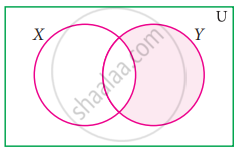
Using the set symbols, write down the expressions for the shaded region in the following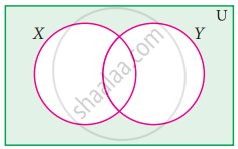
Using the set symbols, write down the expressions for the shaded region in the following.
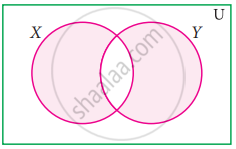
Let A and B be two overlapping set and the universal set be U. Draw appropriate Venn diagram for the following
A ∪ B
Let A and B be two overlapping set and the universal set U. Draw appropriate Venn diagram for the following
A ∩ B
Let A and B be two overlapping set and the universal set U. Draw appropriate Venn diagram for the following
(A ∩ B)’
Let A and B be two overlapping set and the universal set U. Draw appropriate Venn diagram for the following
(B – A)’
Let A and B be two overlapping set and the universal set U. Draw appropriate Venn diagram for the following
A’ ∪ B’
Let A and B be two overlapping set and the universal set U. Draw appropriate Venn diagram for the following:
A’ ∩ B’
Let A and B be two overlapping set and the universal set U. Draw appropriate Venn diagram for the following
What do you observe from (A ∩ B)′ and A′ ∪ B′?
Samacheer Kalvi solutions for Mathematics [English] Class 9 TN Board 1 Set Language Exercise 1.4 [Page 22]
If P = {1, 2, 5, 7, 9}, Q = {2, 3, 5, 9, 11}, R = {3, 4, 5, 7, 9} and S = {2, 3, 4, 5, 8} then find (P ∪ Q) ∪ R
If P = {1, 2, 5, 7, 9}, Q = {2, 3, 5, 9, 11}, R = {3, 4, 5, 7, 9} and S = {2, 3, 4, 5, 8} then find (P ∩ Q) ∩ S
If P = {1, 2, 5, 7, 9}, Q = {2, 3, 5, 9, 11}, R = {3, 4, 5, 7, 9} and S = {2, 3, 4, 5, 8} then find (Q ∩ S) ∩ R
Test for the commutative property of union and intersection of the sets
P = {x : x is a real number between 2 and 7} and
Q = {x : x is an rational number between 2 and 7}
If A = {p, q, r, s}, B = {m, n, q, s, t} and C = {m, n, p, q, s}, then verify the associative property of union of sets
Verify the associative property of intersection of sets for A = `{-11, sqrt(2), sqrt(5), 7}`, B = `{sqrt(3), sqrt(5), 6, 13}` and C = `{sqrt(2), sqrt(3), sqrt(5), 9}`
If A = {x : x = 2n, n ∈ W and n < 4}, B = {x : x = 2n, n ∈ N and n ≤ 4} and C = {0, 1, 2, 5, 6}, then verify the associative property of intersection of sets
Samacheer Kalvi solutions for Mathematics [English] Class 9 TN Board 1 Set Language Exercise 1.5 [Page 28]
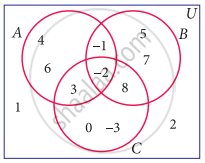
Using the adjacent Venn diagram, find the following set:
A – B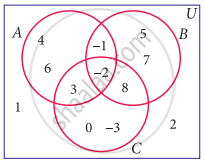
Using the adjacent Venn diagram, find the following set:
B – C
Using the adjacent Venn diagram, find the following set:
A’ ∪ B’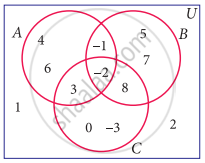
Using the adjacent Venn diagram, find the following set:
A’ ∩ B’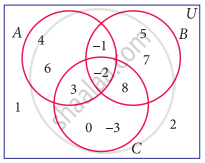
Using the adjacent Venn diagram, find the following set:
(B ∪ C)’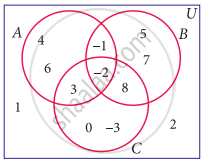
Using the adjacent Venn diagram, find the following set:
A – (B ∪ C)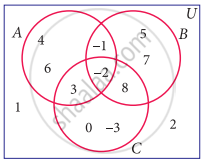
Using the adjacent Venn diagram, find the following set:
A – (B ∩ C)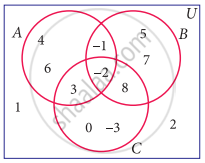
If K = {a, b, d, e, f}, L = {b, c, d, g} and M = {a, b, c, d, h} then find the following:
K ∪ (L ∩ M)
If K = {a, b, d, e, f}, L = {b, c, d, g} and M = {a, b, c, d, h} then find the following:
K ∩ (L ∪ M)
If K = {a, b, d, e, f}, L = {b, c, d, g} and M = {a, b, c, d, h} then find the following:
(K ∪ L) ∩ (K ∪ M)
If K = {a, b, d, e, f}, L = {b, c, d, g} and M = {a, b, c, d, h} then find the following:
(K ∩ L) ∪ (K ∩ M) and verify distributive laws
If A = {x : x ∈ Z, −2 < x ≤ 4}, B = {x : x ∈ W, x ≤ 5}, C = {− 4, −1, 0, 2, 3, 4} verify A ∪ (B ∩ C) = (A ∪ B) ∩ (A ∪ C)
Verify A ∪ (B ∩ C) = (A ∪ B) ∩ (A ∪ C) using Venn diagrams
If A = {b, c, e, g, h}, B = {a, c, d, g, i}, and C = {a, d, e, g, h}, then show that A – (B ∩ C) = (A – B) ∪ (A – C)
If A = {x : x = 6n, n ∈ W and n < 6}, B = {x : x = 2n, n ∈ N and 2 < n ≤ 9} and C = {x : x = 3n, n ∈ N and 4 ≤ n < 10}, then show that A – (B ∩ C) = (A – B) ∪ (A – C)
If A = {– 2, 0, 1, 3, 5}, B = {–1, 0, 2, 5, 6} and C = {–1, 2, 5, 6, 7}, then show that A – (B ∪ C) = (A – B) ∩ (A – C)
If A = `{y : y = ("a"+1)/2, "a" ∈ "W" and "a" ≤ 5}`, B = `{y : y = (2"n" – 1)/2, "n" ∈ "W" and "n" < 5}` and C = `{-1, −1/2, 1, 3/2, 2}` then show that A – (B ∪ C) = (A – B) ∩ (A – C)
Verify A – (B ∩ C) = (A – B) ∪ (A – C) using Venn diagrams
If U = {4, 7, 8, 10, 11, 12, 15, 16}, A = {7, 8, 11, 12} and B = {4, 8, 12, 15}, then verify De Morgan’s Laws for complementation
Verify (A ∩ B)’ = A’ ∪ B’ using Venn diagrams
Samacheer Kalvi solutions for Mathematics [English] Class 9 TN Board 1 Set Language Exercise 1.6 [Pages 35 - 36]
If n(A) = 25, n(B) = 40, n(A ∪ B) = 50 and n(B’) = 25, find n(A ∩ B) and n(U).
If n(A) = 300, n(A ∪ B) = 500, n(A ∩ B) = 50 and n(B’) = 350, find n(B) and n(U)
If U = {x : x ∈ N, x ≤ 10}, A = {2, 3, 4, 8, 10} and B = {1, 2, 5, 8, 10}, then verify that n(A ∪ B) = n(A) + n(B) – n(A ∩ B)
Verify n(A ∪ B ∪ C) = n(A) + n(B) + n(C) – n(A ∩ B) – n(B ∩ C) – n(A ∩ C) + n(A ∩ B ∩ C) for the following sets
A = {a, c, e, f, h}, B = {c, d, e, f} and C = {a, b, c, f}
Verify n(A ∪ B ∪ C) = n(A) + n(B) + n(C) – n(A ∩ B) – n(B ∩ C) – n(A ∩ C) + n(A ∩ B ∩ C) for the following sets
A = {1, 3, 5}, B = {2, 3, 5, 6}, C = {1, 5, 6, 7}
In a class, all students take part in either music or drama or both. 25 students take part in music, 30 students take part in drama and 8 students take part in both music and drama. Find the number of students who take part in only music
In a class, all students take part in either music or drama or both. 25 students take part in music, 30 students take part in drama and 8 students take part in both music and drama. Find the number of students who take part in only drama
In a class, all students take part in either music or drama or both. 25 students take part in music, 30 students take part in drama and 8 students take part in both music and drama. Find the total number of students in the class
In a party of 45 people, each one likes tea or coffee or both. 35 people like tea and 20 people like coffee. Find the number of people who like both tea and coffee
In a party of 45 people, each one likes tea or coffee or both. 35 people like tea and 20 people like coffee. Find the number of people who do not like tea
In a party of 45 people, each one likes tea or coffee or both. 35 people like tea and 20 people like coffee. Find the number of people who do not like coffee
In an examination 50% of the students passed in Mathematics and 70% of students passed in Science while 10% students failed in both subjects. 300 students passed in both the subjects. Find the total number of students who appeared in the examination, if they took examination in only two subjects
A and B are two sets such that n(A – B) = 32 + x, n(B – A) = 5x and n(A ∩ B) = x. Illustrate the information by means of a Venn diagram. Given that n(A) = n(B). Calculate the value of x
Out of 500 car owners investigated, 400 owned car A and 200 owned car B, 50 owned both A and B cars. Is this data correct?
In a colony, 275 families buy Tamil newspaper, 150 families buy English newspaper, 45 families buy Hindi newspaper, 125 families buy Tamil and English newspaper, 17 families buy English and Hindi newspapers, 5 families buy Tamil and Hindi newspaper and 3 families buy all the three newspaper. If each family buy atleast one of these newspaper then find Number of families buy only one newspaper
In a colony, 275 families buy Tamil newspaper, 150 families buy English newspaper, 45 families buy Hindi newspaper, 125 families buy Tamil and English newspaper, 17 families buy English and Hindi newspapers, 5 families buy Tamil and Hindi newspaper and 3 families buy all the three newspaper. If each family buy atleast one of these newspaper then find Number of families buy atleast two newspaper
In a colony, 275 families buy Tamil newspaper, 150 families buy English newspaper, 45 families buy Hindi newspaper, 125 families buy Tamil and English newspaper, 17 families buy English and Hindi newspapers, 5 families buy Tamil and Hindi newspaper and 3 families buy all the three newspaper. If each family buy atleast one of these newspaper then find Total number of families in the colony
A survey of 1000 farmers found that 600 grew paddy, 350 grew ragi, 280 grew corn, 120 grew paddy and ragi, 100 grew ragi and corn, 80 grew paddy and corn. If each farmer grew atleast anyone of the above three, then find the number of farmers who grew all the three.
In the adjacent diagram, if n(U) = 125, y is two times of x and z is 10 more than x, then find the value of x, y and z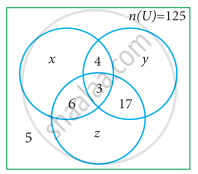
Each student in a class of 35 plays atleast one game among chess, carrom and table tennis. 22 play chess, 21 play carrom, 15 play table tennis, 10 play chess and table tennis, 8 play carrom and table tennis and 6 play all the three games. Find the number of students who play chess and carrom but not table tennis (Hint: Use Venn diagram)
Each student in a class of 35 plays atleast one game among chess, carrom and table tennis. 22 play chess, 21 play carrom, 15 play table tennis, 10 play chess and table tennis, 8 play carrom and table tennis and 6 play all the three games. Find the number of students who play only chess (Hint: Use Venn diagram)
Each student in a class of 35 plays atleast one game among chess, carrom and table tennis. 22 play chess, 21 play carrom, 15 play table tennis, 10 play chess and table tennis, 8 play carrom and table tennis and 6 play all the three games. Find the number of students who play only carrom (Hint: Use Venn diagram)
In a class of 50 students, each one come to school by bus or by bicycle or on foot. 25 by bus, 20 by bicycle, 30 on foot and 10 students by all the three. Now how many students come to school exactly by two modes of transport?
Samacheer Kalvi solutions for Mathematics [English] Class 9 TN Board 1 Set Language Exercise 1.7 [Pages 36 - 37]
Multiple Choice Questions
Which of the following is correct?
{7} ∈ {1, 2, 3, 4, 5, 6, 7, 8, 9, 10}
7 ∈ {1, 2, 3, 4, 5, 6, 7, 8, 9, 10}
7 ∉ {1, 2, 3, 4, 5, 6, 7, 8, 9, 10}
{7} ⊄ {1, 2, 3, 4, 5, 6, 7, 8, 9, 10}
The set P = {x | x ∈ Z, −1 < x <1} is a
Singleton set
Power set
Null set
Subset
If U = {x | x ∈ N, x < 10} and A = {x | x ∈ N, 2 ≤ x < 6} then (A’)’ is
{1, 6, 7, 8, 9}
{1, 2, 3, 4}
{2, 3, 4, 5}
{ }
If B ⊆ A then n(A ∩ B) is
n(A – B)
n(B)
n(B – A)
n(A)
If A = {x, y, z} then the number of non-empty subsets of A is
8
5
6
7
Which of the following is correct?
Ø ⊆ {a, b}
Ø ∈ {a, b}
{a} ∈ {a, b}
a ⊆ {a, b}
If A ∪ B = A ∩ B then
A ≠ B
A = B
A ⊂ B
B ⊂ A
If B – A is B, then A ∩ B is
A
B
U
Ø
From the adjacent diagram n[P(AΔB)] is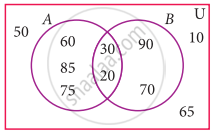
8
16
32
64
If n(A) = 10 and n(B) = 15, then the minimum and maximum number of elements in A ∩ B is
10, 15
15, 10
10, 0
0, 10
Let A = {Ø} and B = P(A) then A ∩ B is
{Ø, {Ø}}
{Ø}
Ø
{0}
In a class of 50 boys, 35 boys play Carrom and 20 boys play Chess then the number of boys play both games is
5
30
15
10
If U = {x : x ∈ N and x < 10}, A = {1, 2, 3, 5, 8} and B = {2, 5, 6, 7, 9}, then n[(A ∪ B)’] is
1
2
4
8
For any three sets P, Q and R, P – (Q ∩ R) is
P – (Q ∪ R)
(P ∩ Q) – R
(P – Q) ∪ (P – R)
(P – Q) ∩ (P – R)
Which of the following is true?
A – B = A ∩ B
A – B = B – A
(A ∪ B)’ = A’ ∪ B’
(A ∩ B)’ = A’ ∪ B’
If n(A ∪ B ∪ C) = 100, n(A) = 4x, n(B) = 6x, n(C) = 5x, n(A ∩ B) = 20, n(B ∩ C) = 15, n(A ∩ C) = 25 and n(A ∩ B ∩ C) = 10, then the value of x is
10
15
25
30
For any three sets A, B and C, (A – B) ∩ (B – C) is equal to
A only
B only
C only
ϕ
If J = Set of three sided shapes, K = Set of shapes with two equal sides and L = Set of shapes with right angle, then J ∩ K ∩ L is
Set of isosceles triangles
Set of equilateral triangles
Set of isosceles right triangles
Set of right angled triangles
The shaded region in the Venn diagram is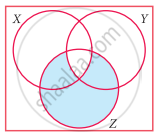
Z – (X ∪ Y)
(X ∪ Y) ∩ Z
Z – (X ∩ Y)
Z ∪ (X ∩ Y)
In a city, 40% people like only one fruit, 35% people like only two fruits, 20% people like all the three fruits. How many percentage of people do not like any one of the above three fruits?
5
8
10
15
Solutions for 1: Set Language
Samacheer Kalvi solutions for Mathematics [English] Class 9 TN Board chapter 1 - Set Language
Shaalaa.com has the Tamil Nadu Board of Secondary Education Mathematics Mathematics [English] Class 9 TN Board Tamil Nadu Board of Secondary Education solutions in a manner that help students grasp basic concepts better and faster. The detailed, step-by-step solutions will help you understand the concepts better and clarify any confusion. Samacheer Kalvi solutions for Mathematics Mathematics [English] Class 9 TN Board Tamil Nadu Board of Secondary Education 1 (Set Language) include all questions with answers and detailed explanations. This will clear students' doubts about questions and improve their application skills while preparing for board exams.
Further, we at Shaalaa.com provide such solutions so students can prepare for written exams. Samacheer Kalvi textbook solutions can be a core help for self-study and provide excellent self-help guidance for students.
Concepts covered in Mathematics [English] Class 9 TN Board chapter 1 Set Language are Cardinality of a Set, Concept of Sets, Properties of Set Operations, De Morgan’s Laws, Representation of a Set, Types of Sets.
Using Samacheer Kalvi Mathematics [English] Class 9 TN Board solutions Set Language exercise by students is an easy way to prepare for the exams, as they involve solutions arranged chapter-wise and also page-wise. The questions involved in Samacheer Kalvi Solutions are essential questions that can be asked in the final exam. Maximum Tamil Nadu Board of Secondary Education Mathematics [English] Class 9 TN Board students prefer Samacheer Kalvi Textbook Solutions to score more in exams.
Get the free view of Chapter 1, Set Language Mathematics [English] Class 9 TN Board additional questions for Mathematics Mathematics [English] Class 9 TN Board Tamil Nadu Board of Secondary Education, and you can use Shaalaa.com to keep it handy for your exam preparation.
