Advertisements
Advertisements
y = −9x not passes through the origin
Concept: undefined >> undefined
Will a line pass through (2, 2) if it intersects the axes at (2, 0) and (0, 2)
Concept: undefined >> undefined
Advertisements
A line passing through (4, – 2) and intersects the Y-axis at (0, 2). Find a point on the line in the second quadrant
Concept: undefined >> undefined
Find the point of intersection of the line joining points (– 3, 7) (2, – 4) and (4, 6) (–5, – 7). Also, find the point of intersection of these lines and also their intersection with the axis.
Concept: undefined >> undefined
Solve for x: `(2^(2x - 1))/(2^(x + 2))` = 4
Concept: undefined >> undefined
Solve for x: `(5^5 xx 5^(-4) xx 5^x)/(5^12)` = 5−5
Concept: undefined >> undefined
If 2m – 1 + 2m + 1 = 640, then find m
Concept: undefined >> undefined
Scale for the given graph,
On the x-axis 1 cm = _________ units
y-axis 1 cm = _________ units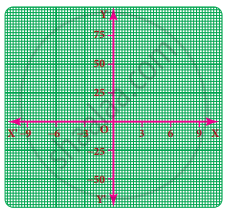
Concept: undefined >> undefined
If the points P(5, 3) Q(−3, 3) R(−3, −4) and S form a rectangle then find the coordinate of S
Concept: undefined >> undefined
A line passes through (6, 0) and (0, 6) and an another line passes through (−3, 0) and (0, −3). What are the points to be joined to get a trapezium?
Concept: undefined >> undefined
The simplified form of `(256)^((-1)/4) xx 4^2` is `1/4`
Concept: undefined >> undefined
Evaluate: `(4/5)^(-2) ÷ (4/5)^(-3)`
Concept: undefined >> undefined
Simplify using law of exponents.
188 ÷ 184
Concept: undefined >> undefined
