Advertisements
Advertisements
Give geographical reasons:
The eastern coastal part of the Indian Ocean is seismically active.
Concept: undefined >> undefined
On an outline map of the world, locate the following, and make an index:
- Sunda Trench
- Diego Garcia
- SW Monsoon
- Agulhas Current
- West Australian Current
- Ninety East ridge
- Strait of Holmuz
- Chabahar port
Concept: undefined >> undefined
Advertisements
Look at the figure Answer the following questions:
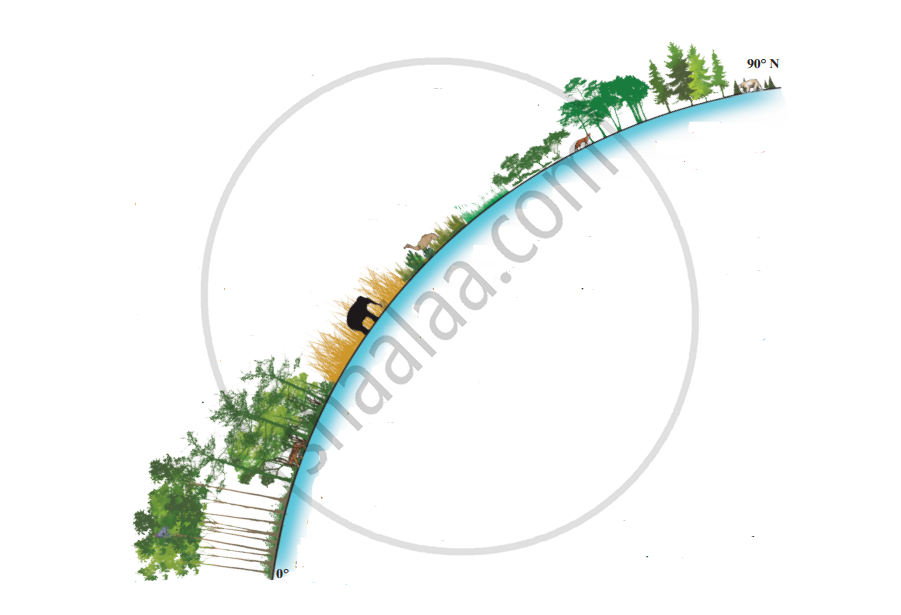
- What does the figure show?
- What do the numbers on the figure represent?
- How does latitude influence the vegetation?
- How does latitude influence the fauna of a place?
- Which latitude will have more biodiversity?
Concept: undefined >> undefined
Besides latitudes, what other conditions influence the biome?
Concept: undefined >> undefined
In which region in India, is desertification occurring?
Concept: undefined >> undefined
Read the following news item.
A grizzly bear that killed a mother and her baby in Yukon last fall was emaciated and desperately pursuing unusual food sources at the time of the attack, according to an investigation by the territory’s government. Valérie Théorêt, 37, and her 10-month-old daughter, Adèle Roesholt, died on Nov. 26, 2018, when a grizzly bear attacked them near their trapping cabin in the remote Einarson Lake area northeast of the village of Mayo. Gordon Hitchcock, chief conservation officer for the Government of Yukon, said the 18-year-old male grizzly bear was emaciated to the point that it was incapable of hibernation. Additionally, it was insignificant and chronic pain from having eaten a porcupine – which bears do not typically eat – and had quills penetrating its digestive system from the mouth to stomach. “This bear had started turning to uncommon food sources,” said Mr. Hitchcock, who presented findings of a necropsy in Whitehorse on Wednesday. - CNN News
- Why do such things occur?
- Give examples of such similar incidents in Maharashtra wherein some animal has attacked people in a particular region.
Concept: undefined >> undefined
Complete the chain:
| A | B | C |
| 1) Boreal forest | 1) Hard wood species of trees | 1) Siberia |
| 2) Deserts | 2) Tropical deciduous forest | 2) Myanmar |
| 3) Teak | 3) Wide spectrum of bio-diversity | 3) Sahara Desert |
| 4) Tropical rain forest | 4) Tundra Region | 4) Brazil |
| 5) Taiga forest | 5) Greenland | |
| 6) Narrow spectrum of bio-diversity |
Concept: undefined >> undefined
Fill in the blank with appropriate alternatives given below and rewrite the sentence.
Ecosystem consists of interaction between ____________ and abiotic factors.
Concept: undefined >> undefined
Fill in the blank with appropriate alternatives given below and rewrite the sentence.
The original meaning of savanna is____________
Concept: undefined >> undefined
Arrange the given statements as per given instructions.
Arrange the following biomes in proper order from the Equator to Pole.
- Tundra
- Tropical rain forest
- Boreal forest
- Sahara desert
Concept: undefined >> undefined
Write notes on Disaster.
Concept: undefined >> undefined
Choose the correct alternative :
Statement A - The cyclonic depression originating in the Bay of Bengal is marching towards Tamil Nadu at a velocity of 350 km/ hr.
Statement B - The loss of life was not much but property loss occurred on a large scale.
Concept: undefined >> undefined
Read about the following disasters which have occurred across the world and answer the following questions.
| Major Disasters |
|||
| Year | Disaster | Location | No. of deaths/loss incurred (approx.) |
| 1920 | Earthquake | China | 2,35,000 |
| 1923 | Earthquake | Japan | 1,42,000 |
| 1970 | Bhola Cyclone | India and Bangladesh | 5,00,000 |
| 1984 | Release of gas Methyl Isocyanate | Bhopal, India | 10,000; 5.5lakh affected |
| 1985 | Ruiz Volcanic Eruption | Colombia | 25,000 |
| 1994 | Landslide | Varandha Ghat, Maharashtra, India | 20; Breaching of ghat road, Konkan Coast damaged to the extent of 1 km at several places |
| 1995 | Rail accident | Firozabad, India | 400 |
| 1999 | Cyclone | Odisha, India | 10,000 |
| 2004 | Tsunami | India, Indonesia, Sri Lanka | 2,50,000 |
| 2005 | Earthquake | India and Pakistan | 80,000 |
| 2005 | Flash Floods | Mumbai, India | 1100 |
| 2014 | Hailstorm | Maharashtra, India | Affected many standing crops, 2700 farm animals dead |
| 2019 | Cyclone Fani | Odisha, India | 89 |
- Classify these disasters into natural and man-made disasters.
- Which of these disasters occurred due to climatic conditions?
- Which of these disasters occurred due to geological causes?
- Can you relate the location of a disaster with its cause?
- Besides the number of deaths, what other losses might be occurring after the disasters?
- Comparing the cyclones of 1999 and 2019, can you think of the reasons behind the reduction in the number of deaths?
- Which of these disasters can be predicted in advance?
- Of those disasters for which prediction can be made, can the people be evacuated from the area?
- Why do some people get affected by the disaster in specific regions?
Concept: undefined >> undefined
If an earthquake occurs with a magnitude of more than 6 in the Sahara desert area which is totally uninhabited by humans and a similar one occurs in Assam, which one would you call a disaster?
Concept: undefined >> undefined
Given below is a list of measures taken for disaster. Write whether they are pre-disaster or post-disaster and structural or non-structural. Also, write the name of the disaster for which they are used. Complete the table.
| Sr. No. | Measures | Pre-disaster/ Post-disaster | Structural/ Nonstructural | Disaster/(s) to which they are applicable |
| 1. | Conducting mock drills. | Pre-disaster | Non-structural | Earthquake, Landslides, Fire |
| 2. | Discussions about disaster risks and community problems and solutions. | |||
| 3. | Using art, documentaries, music, and drama to portray the impact of disasters on communities | |||
| 4. | Inviting emergency services personnel to provide lectures/ demonstrations. | |||
| 5. | Making booklets on disaster-related information. | |||
| 6. | Retrofit old buildings | |||
| 7. | Constructing shelters and evacuation chambers. | |||
| 8. | Making a change in land use policy regarding the construction of houses in low-lying areas. | |||
| 9. | Constructing buildings and houses using disaster-resistant material, designed to comply with relevant BIS (Bureau of Indian Standards) codes. | |||
| 10. | Constructing proper drains. | |||
| 11. | Carrying out plantation activities. | |||
| 12. | Regular disaster-related activities through radio, TV newspapers, etc. | |||
| 13. | Using satellites for early warning. | |||
| 14. | Evacuation routes in disaster management plans should be delineated |
Concept: undefined >> undefined
Assertion (A): In areas of high rainfall, slides are very common.
Reasoning (R): Types of mass wasting movements are dependent on a region's climate.
Concept: undefined >> undefined
A: Gravity is a major factor in mass wasting.
R: Gravity pulls all things down to the earth’s surface.
Concept: undefined >> undefined
A: Freeze and thaw weathering is common in desert areas.
R: Water gets into cracks and breaks the rocks.
Concept: undefined >> undefined
Identify the correct correlation:
A: Assertion; R: Reasoning
A: Surface water helps solifluction.
R: Water table is responsible for the same.
Concept: undefined >> undefined
Identify the correct group:
Concept: undefined >> undefined
